> For the complete documentation index, see [llms.txt](https://hacking-notes.jord4n.pro/llms.txt). Markdown versions of documentation pages are available by appending `.md` to page URLs; this page is available as [Markdown](https://hacking-notes.jord4n.pro/de/privesc/cron-jobs/pspy64-cron-enumeration-linux-privilege-escalation.md).
# pspy64-Tool - Linux-Privilegienerweiterung
Notizen zum pspy64-Tool zur Linux-Privilegienerweiterung, mit Enumerierungsschritten, Ausnutzungsbeispielen und validierungsorientierter Berichterstattung.
## Was es ist
Cron-Jobs erstellen Privilegieneskalationspfade, wenn wiederkehrende Root-Aufgaben schreibbare Skripte, unsichere relative Pfade oder verwundbare Prozessoren ausführen. Der Schlüssel besteht darin nachzuweisen, dass ein Benutzer mit geringen Rechten etwas kontrolliert, das eine privilegierte geplante Aufgabe ausführen wird. Diese spezielle Seite konzentriert sich auf **pspy64-Tool** und hält den Ausnutzungsablauf praxisnah: die Bedingung identifizieren, sie sicher validieren und dann die kleinste nötige Nutzlast ausführen, um die Auswirkung nachzuweisen.
## Aufzählung
Beginnen Sie damit, den lokalen Kontext und die genaue Fehlkonfiguration zu bestätigen, bevor Sie den Ausnutzungsweg ausführen.
```bash
cat /etc/crontab
ls -la /etc/cron.*
systemctl list-timers --all
```
## Beispiele
## pspy64-Tool
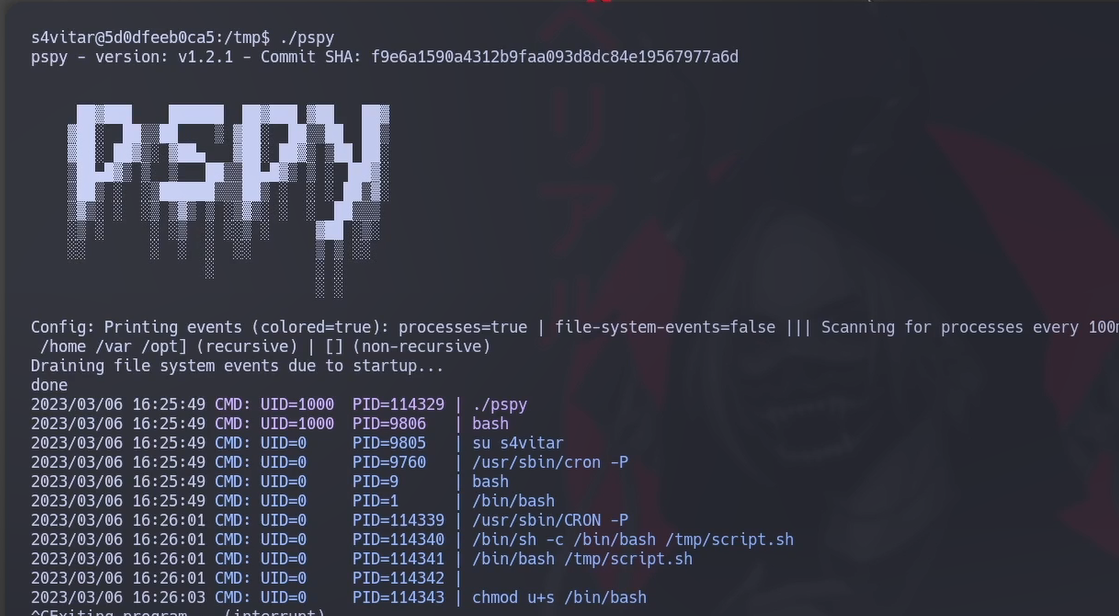
Das Tool [pspy64](https://github.com/DominicBreuker/pspy/releases) erkennt Cron-Jobs automatisch. **Pspy** ist ein Kommandozeilenwerkzeug, das Aufgaben überwacht, die im Hintergrund auf einem Unix/Linux-System laufen, und neue Aufgaben anzeigt, die gestartet werden.
---
# Agent Instructions
This documentation is published with GitBook. GitBook is the documentation platform designed so that both humans and AI agents can read, navigate, and reason over technical content effectively. Learn more at gitbook.com.
## Querying This Documentation
If you need additional information that is not directly available in this page, you can query the documentation by asking a question.
Perform an HTTP GET request on the following URL with the `ask` and `goal` query parameters:
```
GET https://hacking-notes.jord4n.pro/de/privesc/cron-jobs/pspy64-cron-enumeration-linux-privilege-escalation.md?ask=&goal=
```
`ask` is the immediate question: it should be specific, self-contained, and written in natural language.
`goal` is what the user is ultimately trying to achieve, the reason they need the answer. Sharing it helps GitBook give you a better, more relevant answer. A goal is most helpful when it describes the outcome the user wants rather than restating the question. For example, with `ask=how do I create an API token`, a goal like `automate deployments from our CI pipeline` lets GitBook tailor the answer to that use case.
The response will contain a direct answer to the question and relevant excerpts and sources from the documentation.
Use this mechanism when the answer is not explicitly present in the current page, you need clarification or additional context, or you want to retrieve related documentation sections.