> For the complete documentation index, see [llms.txt](https://hacking-notes.jord4n.pro/llms.txt). Markdown versions of documentation pages are available by appending `.md` to page URLs; this page is available as [Markdown](https://hacking-notes.jord4n.pro/es/web/csrf/csrf-token-not-tied-to-session.md).
# CSRF con token no vinculado a la sesión
Notas de CSRF con token no vinculado a la sesión para laboratorios de PortSwigger Web Security Academy, incluido el flujo de explotación, pruebas de payloads, validación con Burp Suite y contexto de remediación.
### CSRF donde el token no está vinculado a la sesión del usuario
#### Objetivo del laboratorio
Cambia la dirección de correo electrónico de la víctima mediante un ataque CSRF. La aplicación usa tokens CSRF, pero estos **no están vinculados a la sesión del usuario**.
#### Observaciones
Cada token CSRF es **válido solo una vez**.
* Los tokens **no están asociados con la sesión**: un token obtenido con el usuario A puede usarse para atacar a B.
#### Estrategia operativa
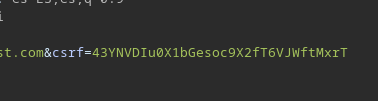
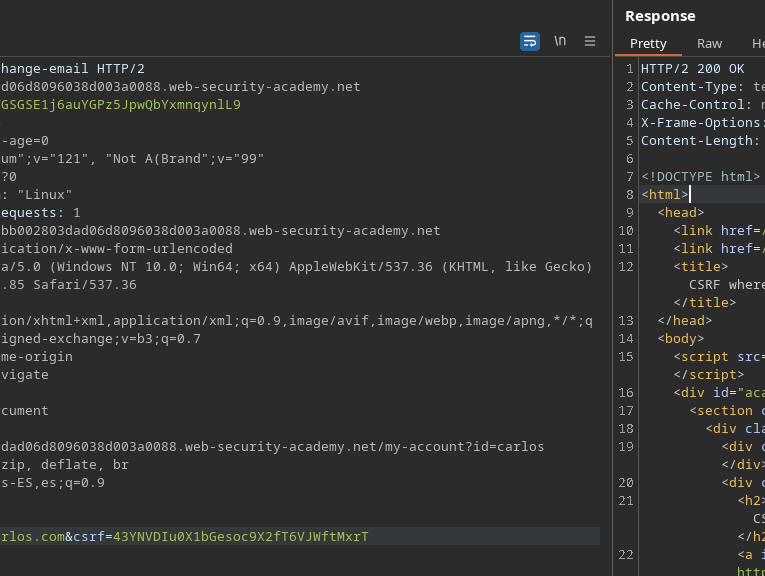
1. **Obtén un nuevo token CSRF** sin usarlo (intercepta una nueva solicitud para obtener un token que siga siendo válido).
2. **Aloja un formulario malicioso** en el servidor de explotación que envía una solicitud POST para cambiar la dirección de correo electrónico reutilizando **este token**.
3. Cuando la víctima visite la página trampa, el formulario se envía automáticamente y **modifica su dirección de correo electrónico**.
```html
```
---
# Agent Instructions
This documentation is published with GitBook. GitBook is the documentation platform designed so that both humans and AI agents can read, navigate, and reason over technical content effectively. Learn more at gitbook.com.
## Querying This Documentation
If you need additional information that is not directly available in this page, you can query the documentation by asking a question.
Perform an HTTP GET request on the following URL with the `ask` and `goal` query parameters:
```
GET https://hacking-notes.jord4n.pro/es/web/csrf/csrf-token-not-tied-to-session.md?ask=&goal=
```
`ask` is the immediate question: it should be specific, self-contained, and written in natural language.
`goal` is what the user is ultimately trying to achieve, the reason they need the answer. Sharing it helps GitBook give you a better, more relevant answer. A goal is most helpful when it describes the outcome the user wants rather than restating the question. For example, with `ask=how do I create an API token`, a goal like `automate deployments from our CI pipeline` lets GitBook tailor the answer to that use case.
The response will contain a direct answer to the question and relevant excerpts and sources from the documentation.
Use this mechanism when the answer is not explicitly present in the current page, you need clarification or additional context, or you want to retrieve related documentation sections.