> For the complete documentation index, see [llms.txt](https://hacking-notes.jord4n.pro/llms.txt). Markdown versions of documentation pages are available by appending `.md` to page URLs; this page is available as [Markdown](https://hacking-notes.jord4n.pro/pt-br/web/authentication/brute-forcing-a-stay-logged-in-cookie.md).
# Força bruta em um cookie de sessão persistente
Notas sobre força bruta em um cookie de sessão persistente para os laboratórios do PortSwigger Web Security Academy, incluindo fluxo de exploração, teste de payload, validação no Burp Suite e contexto de remediação.
### Forçando por brute force um cookie de manter-se conectado
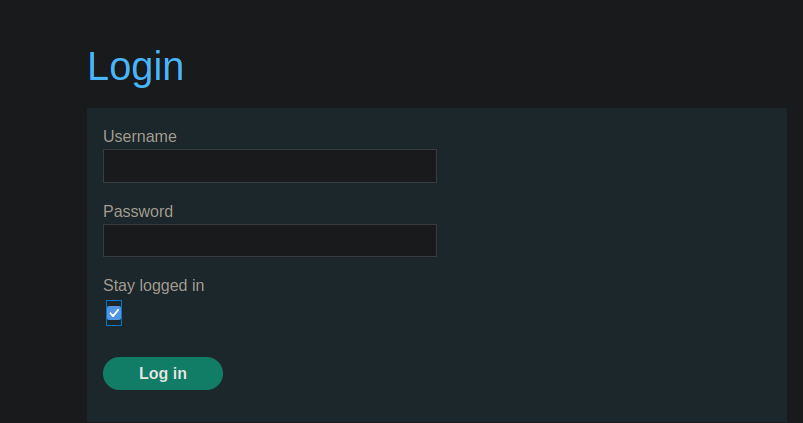
Este laboratório permite que os usuários permaneçam conectados mesmo depois de fecharem o navegador. O cookie usado para esse recurso é vulnerável a força bruta. / Para resolver o laboratório, você precisa forçar por brute force o cookie do Carlos para acessar sua página Minha conta.
**Credenciais fornecidas:** `wiener:peter`/ \*\* Nome da vítima:\*\* `carlos`
### \*\*Análise do Mecanismo
Quando você marca a opção de reconexão automática, a seguinte requisição é enviada:
```bash
username=wiener&password=peter&stay-logged-in=on
```
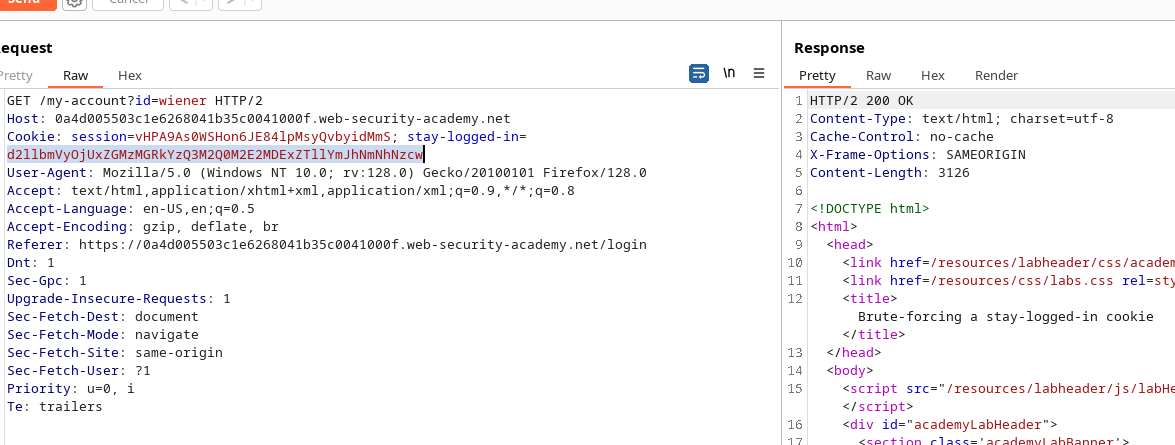
O servidor então retorna um cookie chamado **stay-logged-in**, cujo conteúdo é codificado em Base64:
```bash
d2llbmVyOjUxZGMzMGRkYzQ3M2Q0M2E2MDExZTllYmJhNmNhNzcw
```
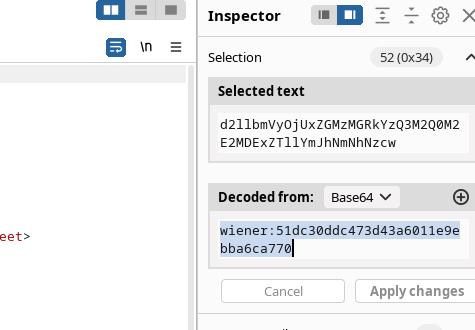
Após a decodificação, obtemos:
```bash
wiener:51dc30ddc473d43a6011e9ebba6ca770
```
A estrutura do cookie, portanto, é:
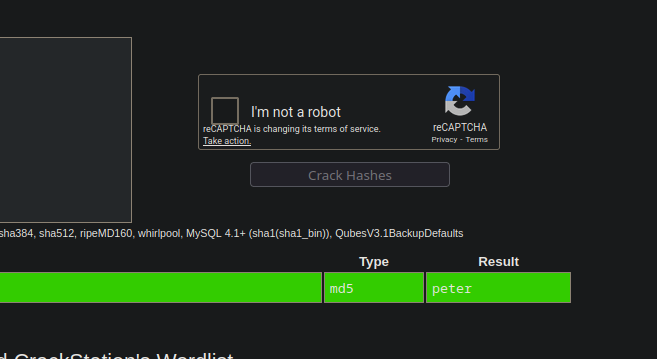
Ao verificar o hash no CrackStation, descobrimos que ele corresponde ao valor **peter** em MD5.
### **Configuração da Força Bruta**
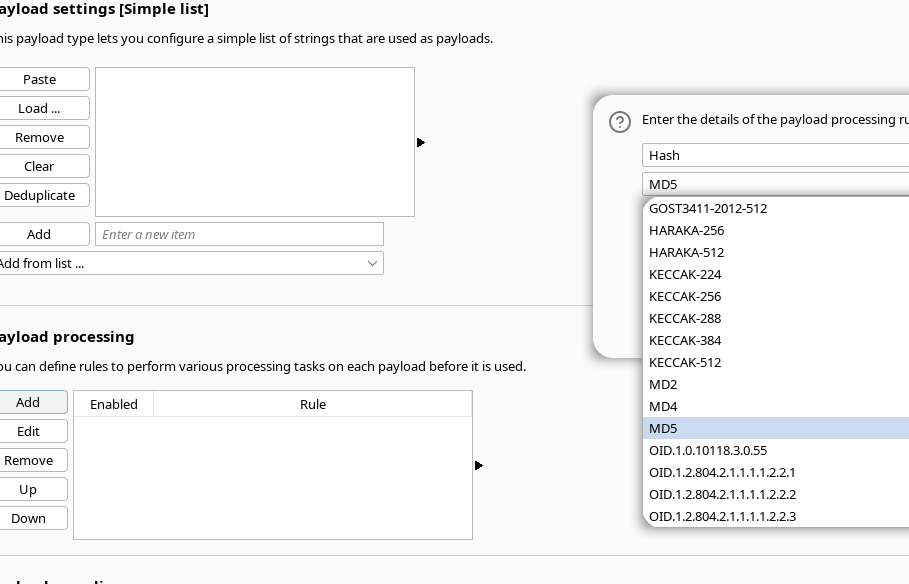
1. Envie a solicitação de cookie para **Burp Intruder** e selecione o valor do cookie como a área de injeção.
Em Processamento de Payload:
* adicione uma transformação que gere um hash **MD5**;
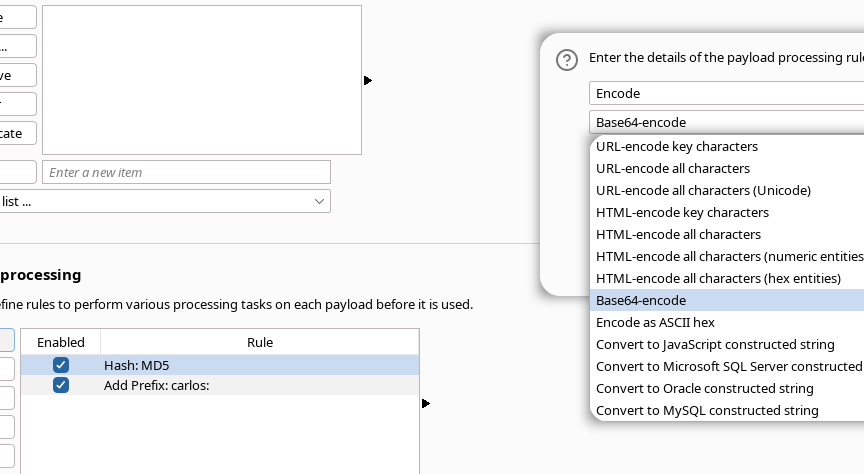
* adicione um prefixo: `carlos:`
* codifique tudo em **Base64**.
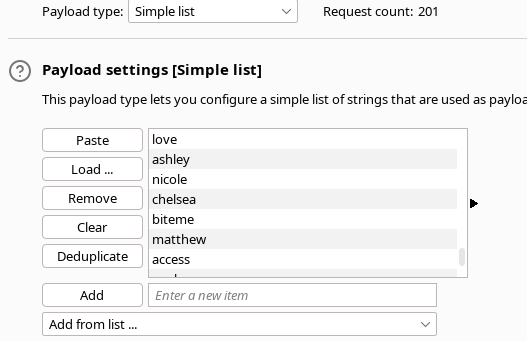
1. Carregue a lista de senhas em Configurações de Payload.
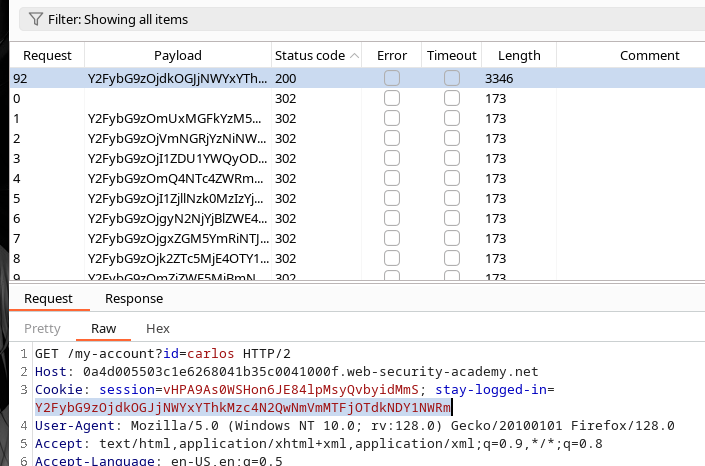
Durante o ataque, uma resposta **200** indica o cookie correto para Carlos.
O cookie obtido é:
```bash
Y2FybG9zOjdkOGJjNWYxYThkMzc4N2QwNmVmMTFjOTdkNDY1NWRm
```
Decodificação
{% code overflow="wrap" %}
```bash
echo -n "Y2FybG9zOjdkOGJjNWYxYThkMzc4N2QwNmVmMTFjOTdkNDY1NWRm" | base64 -d ;echo
```
{% endcode %}
* carlos:7d8bc5f1a8d3787d06ef11c97d4655df
Ao verificar esse hash no CrackStation, descobrimos que a senha associada é **taylor**.
---
# Agent Instructions
This documentation is published with GitBook. GitBook is the documentation platform designed so that both humans and AI agents can read, navigate, and reason over technical content effectively. Learn more at gitbook.com.
## Querying This Documentation
If you need additional information that is not directly available in this page, you can query the documentation by asking a question.
Perform an HTTP GET request on the following URL with the `ask` and `goal` query parameters:
```
GET https://hacking-notes.jord4n.pro/pt-br/web/authentication/brute-forcing-a-stay-logged-in-cookie.md?ask=&goal=
```
`ask` is the immediate question: it should be specific, self-contained, and written in natural language.
`goal` is what the user is ultimately trying to achieve, the reason they need the answer. Sharing it helps GitBook give you a better, more relevant answer. A goal is most helpful when it describes the outcome the user wants rather than restating the question. For example, with `ask=how do I create an API token`, a goal like `automate deployments from our CI pipeline` lets GitBook tailor the answer to that use case.
The response will contain a direct answer to the question and relevant excerpts and sources from the documentation.
Use this mechanism when the answer is not explicitly present in the current page, you need clarification or additional context, or you want to retrieve related documentation sections.