> For the complete documentation index, see [llms.txt](https://hacking-notes.jord4n.pro/llms.txt). Markdown versions of documentation pages are available by appending `.md` to page URLs; this page is available as [Markdown](https://hacking-notes.jord4n.pro/pt-br/web/xss/dom-xss-with-jquery-hashchange-event.md).
# XSS DOM com jQuery e hashchange
Notas sobre XSS DOM com jQuery e hashchange para laboratórios da PortSwigger Web Security Academy, incluindo fluxo de exploração, teste de payloads, validação no Burp Suite e contexto de remediação.
### XSS em DOM no sink de seletor do jQuery usando um evento hashchange
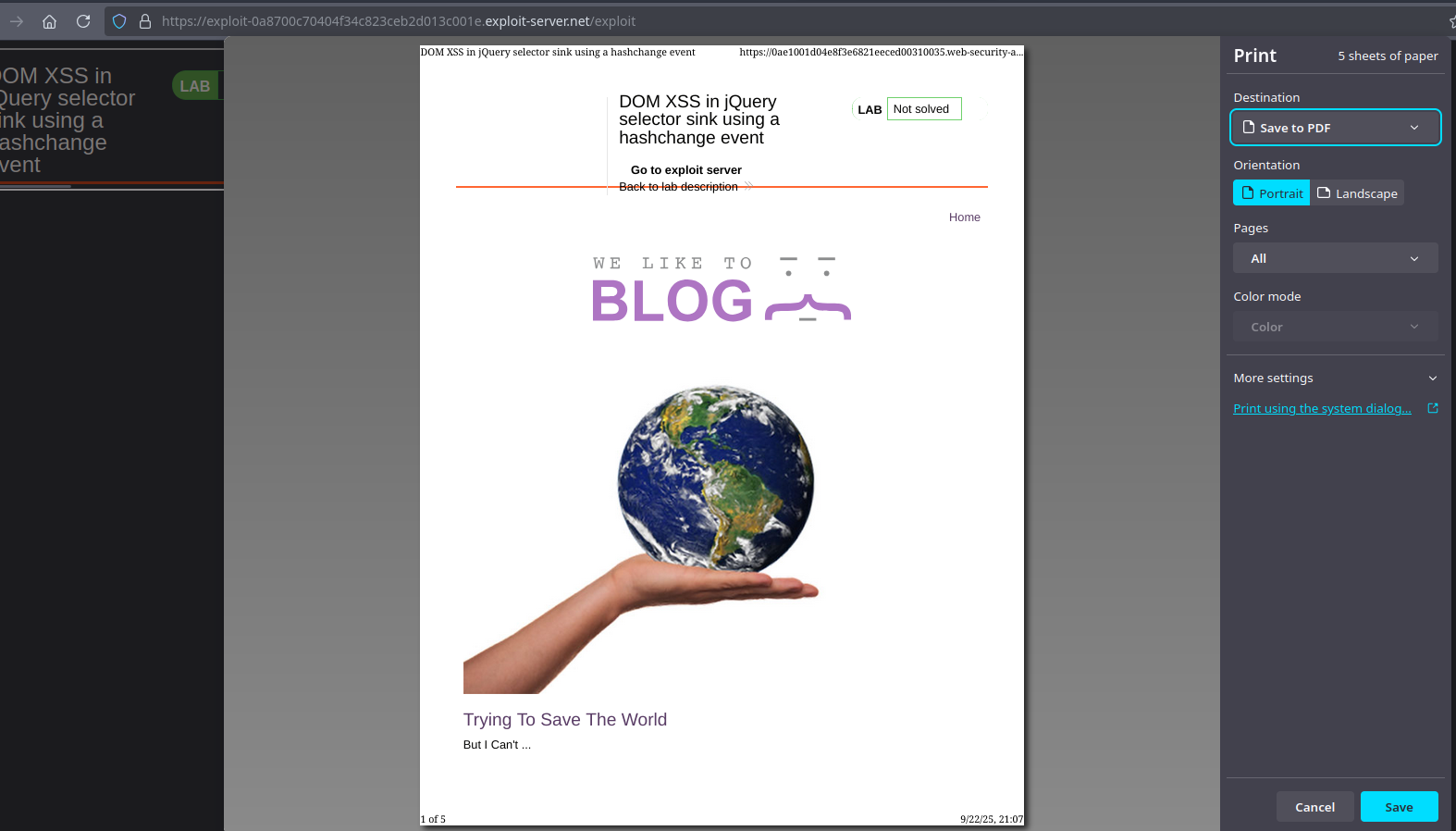
Este laboratório contém uma vulnerabilidade de XSS no lado do cliente na página inicial. O código usa a `$()` função seletora do jQuery para direcionar automaticamente um artigo cujo título foi passado via `location.hash`. O objetivo do laboratório é obter um exploit que, quando um visitante o abrir, chame `print()` no navegador dele.
{% code overflow="wrap" %}
```javascript
$(window).on('hashchange', function(){
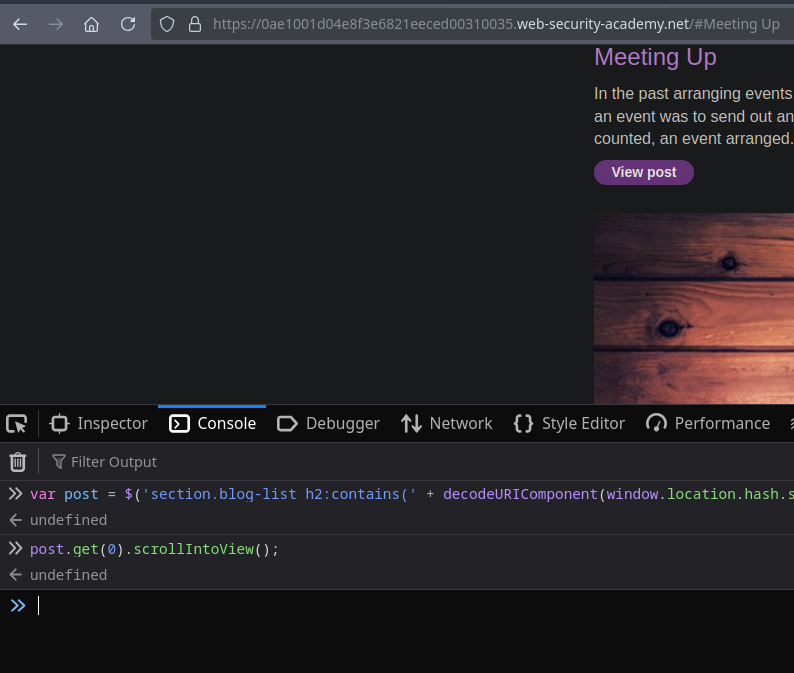
var post = $('section.blog-list h2:contains(' + decodeURIComponent(window.location.hash.slice(1)) + ')');
if (post) post.get(0).scrollIntoView();
});
```
{% endcode %}
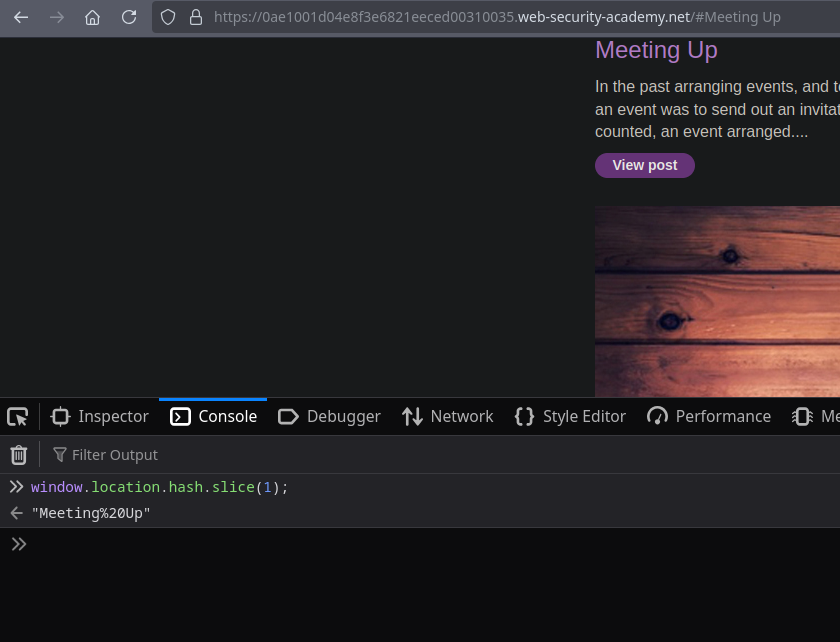
* A função recupera o fragmento da URL (`window.location.hash`), remove o `#` por `slice(1)` e o decodifica com `decodeURIComponent`.
* Esse texto é então concatenado diretamente em um jQuery `:contains(...)` seletor. Como não há escape, conteúdo especialmente construído pode quebrar a sintaxe e injetar HTML/JS por meio de vetores como `onerror` atributos.
* O código só dispara a ação quando o hash muda (`hashchange`), então um link inicial simples sem hash não acionará nada até que o fragmento seja alterado do lado do cliente.
* Aproveitamos o fato de que a modificação de `#` dispara o evento. O exploit deve, portanto, forçar o navegador da vítima a carregar uma URL com um fragmento contendo o payload.
* Um método comum é usar um `
```
{% endcode %}
* Exploit final para `print()` (versão adaptada):
{% code overflow="wrap" %}
```javascript
```
{% endcode %}
---
# Agent Instructions
This documentation is published with GitBook. GitBook is the documentation platform designed so that both humans and AI agents can read, navigate, and reason over technical content effectively. Learn more at gitbook.com.
## Querying This Documentation
If you need additional information that is not directly available in this page, you can query the documentation by asking a question.
Perform an HTTP GET request on the following URL with the `ask` and `goal` query parameters:
```
GET https://hacking-notes.jord4n.pro/pt-br/web/xss/dom-xss-with-jquery-hashchange-event.md?ask=&goal=
```
`ask` is the immediate question: it should be specific, self-contained, and written in natural language.
`goal` is what the user is ultimately trying to achieve, the reason they need the answer. Sharing it helps GitBook give you a better, more relevant answer. A goal is most helpful when it describes the outcome the user wants rather than restating the question. For example, with `ask=how do I create an API token`, a goal like `automate deployments from our CI pipeline` lets GitBook tailor the answer to that use case.
The response will contain a direct answer to the question and relevant excerpts and sources from the documentation.
Use this mechanism when the answer is not explicitly present in the current page, you need clarification or additional context, or you want to retrieve related documentation sections.