> For the complete documentation index, see [llms.txt](https://hacking-notes.jord4n.pro/llms.txt). Markdown versions of documentation pages are available by appending `.md` to page URLs; this page is available as [Markdown](https://hacking-notes.jord4n.pro/ru/web/csrf/csrf-vulnerability-with-no-defenses.md).
# Уязвимость CSRF без защиты
Заметки по уязвимости CSRF без защиты для лабораторных работ PortSwigger Web Security Academy, включая процесс эксплуатации, тестирование полезной нагрузки, проверку в Burp Suite и контекст исправления.
### Уязвимость CSRF без защиты
#### Описание
Функция изменения электронной почты в этой лабораторной работе уязвима к CSRF-атаке. Цель — подделать запрос на стороне клиента, который изменит адрес электронной почты пользователя-жертвы без его согласия.
#### Цель
Создайте HTML-контент, который выполняет CSRF-атаку и изменяет адрес электронной почты посетителя, а затем загрузите этот контент на свой сервер эксплойта.
#### Идентификатор
Вы можете войти в систему с помощью следующей учетной записи:/ **wiener: peter**
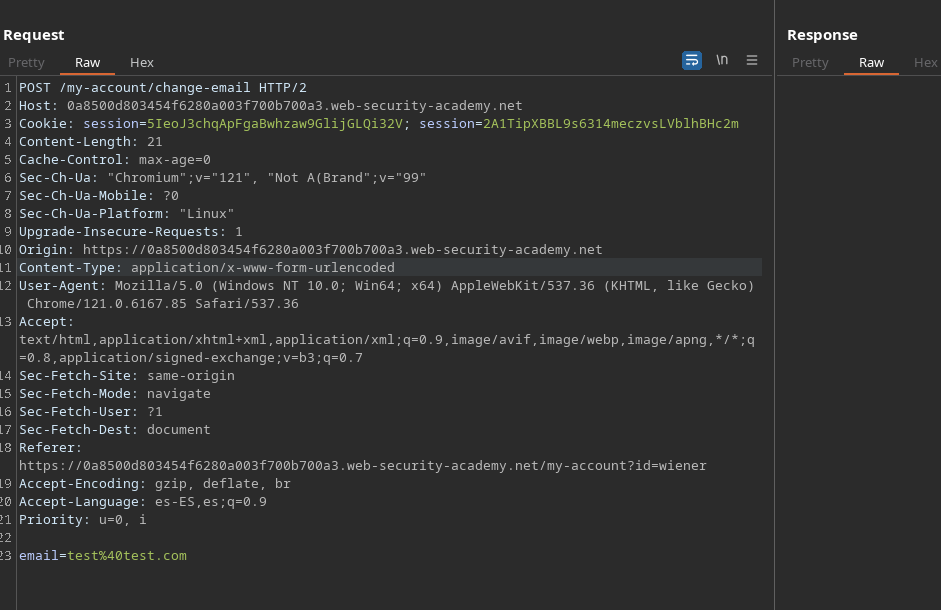
При перехвате видно, что запрос на изменение электронной почты — это простой POST-запрос, принимающий `электронная почта` параметр. Защиты от CSRF нет (ни токена, ни проверки Origin и т. д.), что позволяет автоматизировать отправку формы со страницы, размещённой на сервере эксплойта.
#### HTML полезной нагрузки для размещения на сервере эксплойта
Следующий HTML создаёт форму, отправляющую запрос на URL изменения электронной почты, и автоматически отправляет её при загрузке страницы:
```html
```
---
# Agent Instructions
This documentation is published with GitBook. GitBook is the documentation platform designed so that both humans and AI agents can read, navigate, and reason over technical content effectively. Learn more at gitbook.com.
## Querying This Documentation
If you need additional information that is not directly available in this page, you can query the documentation by asking a question.
Perform an HTTP GET request on the following URL with the `ask` and `goal` query parameters:
```
GET https://hacking-notes.jord4n.pro/ru/web/csrf/csrf-vulnerability-with-no-defenses.md?ask=&goal=
```
`ask` is the immediate question: it should be specific, self-contained, and written in natural language.
`goal` is what the user is ultimately trying to achieve, the reason they need the answer. Sharing it helps GitBook give you a better, more relevant answer. A goal is most helpful when it describes the outcome the user wants rather than restating the question. For example, with `ask=how do I create an API token`, a goal like `automate deployments from our CI pipeline` lets GitBook tailor the answer to that use case.
The response will contain a direct answer to the question and relevant excerpts and sources from the documentation.
Use this mechanism when the answer is not explicitly present in the current page, you need clarification or additional context, or you want to retrieve related documentation sections.