> For the complete documentation index, see [llms.txt](https://hacking-notes.jord4n.pro/llms.txt). Markdown versions of documentation pages are available by appending `.md` to page URLs; this page is available as [Markdown](https://hacking-notes.jord4n.pro/zh/reconnaissance/web-profiling.md).
# Web 指纹识别
Web 指纹识别技术,用于识别目标网站上的技术、框架、CMS、服务器、库和暴露版本。
Web 分析可识别目标技术栈,包括 CMS、框架、Web 服务器、JavaScript 库、分析工具、安全产品以及公开的版本信息。
{% hint style="info" %}
了解网站所使用技术的方法有很多。借助可通过控制台、浏览器扩展或专业网站访问的不同工具,你可以获取某个页面所使用技术的详细信息。以下是几种识别它们的方法:
{% endhint %}
## WhatWeb:
> WhatWeb 是一款非常流行的命令行工具,用于识别网站所使用的技术。它快速且准确,能够检测广泛的技术,包括 CMS、框架、Web 服务器、分析工具等。它的独特之处在于能够分析 HTTP 头、源代码以及页面上的其他元素。
```bash
whatweb https://website.com
```
该命令将为你提供网站所使用技术的详细概览,包括 CMS、JavaScript 库、分析工具以及更多内容。
## BuiltWith:
> [BuiltWith](https://builtwith.com) 是分析网站技术最详细的工具之一。这个在线服务可以全面展示所使用的技术,例如服务器、框架、库、营销和安全工具,甚至某些技术的版本。尽管提供的信息有时可能过于丰富,但这个工具对于获得完整视图仍然非常出色。
## Wappalyzer:
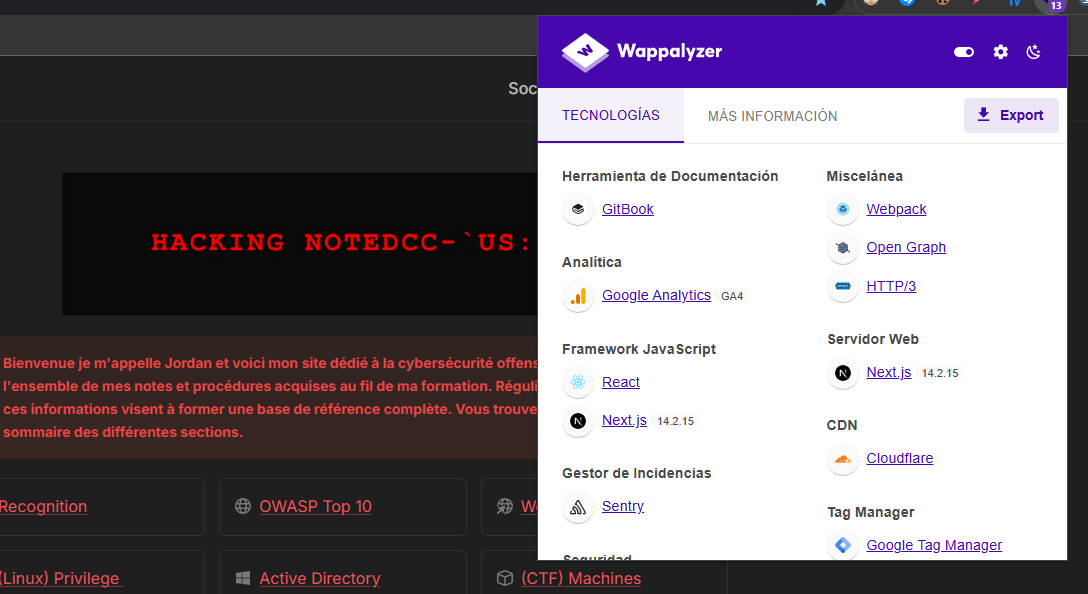
> [Wappalyzer ](https://www.wappalyzer.com/)是一款以简单高效著称的浏览器扩展。只要你访问某个网站,扩展就会自动检测所使用的技术,包括 CMS、Web 服务器、JavaScript 库等。Wappalyzer 的优势之一在于速度,尤其是能够即时提供关键信息。此外,它有时还能显示检测到的技术版本。
---
# Agent Instructions
This documentation is published with GitBook. GitBook is the documentation platform designed so that both humans and AI agents can read, navigate, and reason over technical content effectively. Learn more at gitbook.com.
## Querying This Documentation
If you need additional information that is not directly available in this page, you can query the documentation by asking a question.
Perform an HTTP GET request on the following URL with the `ask` and `goal` query parameters:
```
GET https://hacking-notes.jord4n.pro/zh/reconnaissance/web-profiling.md?ask=&goal=
```
`ask` is the immediate question: it should be specific, self-contained, and written in natural language.
`goal` is what the user is ultimately trying to achieve, the reason they need the answer. Sharing it helps GitBook give you a better, more relevant answer. A goal is most helpful when it describes the outcome the user wants rather than restating the question. For example, with `ask=how do I create an API token`, a goal like `automate deployments from our CI pipeline` lets GitBook tailor the answer to that use case.
The response will contain a direct answer to the question and relevant excerpts and sources from the documentation.
Use this mechanism when the answer is not explicitly present in the current page, you need clarification or additional context, or you want to retrieve related documentation sections.
.png?alt=media)
.png?alt=media)